MCQ
A rigid body is rotating with variable angular velocity $(a - bt)$ at any instant of time $ t.$ The total angle subtended by it before coming to rest will be ($a$ and $b$ are constants)
  • A
    $\frac{{(a - b)\,a}}{2}$
  • $\frac{{{a^2}}}{{2b}}$
  • C
    $\frac{{{a^2} - {b^2}}}{{2b}}$
  • D
    $\frac{{{a^2} - {b^2}}}{{2a}}$

Answer

Correct option: B.
$\frac{{{a^2}}}{{2b}}$
b
$w=a-b t=0$

$t=a / b$

$\theta=\int \omega d t=\int_{0}^{1}(a-b t) d t$

$=\left(a t-\frac{b t^{2}}{2}\right)_{0}^{a/b}$

$=a \cdot \frac{a}{b}-\frac{6}{2} \frac{a^{2}}{b^{2}}$

$=a^{2} / 2 b$

Need a full question paper?

Generate a complete, print-ready paper with questions like this in minutes — across 16+ boards, with answer keys.

Start Generating Free

Similar questions

The velocity v of a particle is given in terms of time t is:
Under isothermal condition, the pressure of a gas is given by $P = aV ^{-3}$, where $a$ is a constant and $V$ is the volume of the gas. The bulk modulus at constant temperature is equal to $..........\,P$
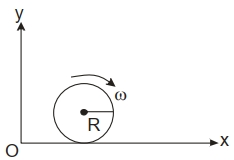
A spherical shell of $1 \,kg$ mass and radius $R$ is rolling with angular speed $\omega$ on horizontal plane (as shown in figure). The magnitude of angular momentum of the shell about the origin $O$ is $\frac{a}{3} R^{2} \omega$. The value of a will be ..............
The area of a sheet of length $10.2 \,cm$ and width $6.8 \,cm$ addressed upto proper number of significant figures is ......... $cm^2$
A body of mass $5\, kg$ is moving in a circle of radius $1\,m$ with an angular velocity of $2$ radian/sec. The centripetal force is ......... $N$
A huge circular arc of length $4.4$ $ly$ subtends an angle $'4 {s}'$ at the centre of the circle. How long it would take for a body to complete $4$ revolution if its speed is $8 \;AU\;per\, second \;?$

Given : $1\, {ly}=9.46 \times 10^{15} \,{m},$ $\, {AU}=1.5 \times 10^{11}\, {m}$

In our solar system, the interplanetary region has chunks of matter (much smaller in size compared to planets) called asteroids. They
  1. Will not move around the sun since they have very small masses compared to sun.
  2. Will move in an irregular way because of their small masses and will drift away into outer space.
  3. Will move around the sun in closed orbits but not obey Kepler’s laws.
  4. Will move in orbits like planets and obey Kepler’s laws.
Two particles of mass $5\, kg$ and $10\, kg$ respectively are attached to the two ends of a rigid rod of length $1\, m$ with negligible mass. The centre of mass of the system from the $5\, kg$ particle is nearly at a distance of $..........\, cm$
A body of mass $m$ moves in a circular path with uniform angular velocity. The motion of the body has constant
The greatest height to which a man can throw a stone is $h$. The greatest distance to which he can throw it, will be