Question
A rigid spherical body is spinning around an axis without any external torque. Due to change in temperature, the volume increases by $1\%$. Its angular speed 

Answer

volume of spherical body, $V=\frac{4}{3} \pi R^{3}$

$\Rightarrow \frac{\Delta V}{V}=3 \frac{\Delta R}{R}$

$\Rightarrow \frac{\Delta R}{R}=0.33$

As there is no external torque angular momentum is conserved, $L=I \omega$

$\Rightarrow L=\frac{2}{5} M R^{2} \omega$

$\Rightarrow \frac{\Delta L}{L}=2 \frac{\Delta R}{R}+\frac{\Delta \omega}{\omega}$

since, $\frac{\Delta L}{L}=0$ as the magnitude is constant.

$\Rightarrow \frac{\Delta \omega}{\omega}=-2 \frac{\Delta R}{R}$

Therefore, $\omega$ decreases by $0.67 \%$

Need a full question paper?

Generate a complete, print-ready paper with questions like this in minutes — across 16+ boards, with answer keys.
Start Generating Free

Similar questions

A body is thrown upwards with velocity 100 m/s and it travels 5 m in the last second of its upward journey. If the same body is thrown upward with velocity 200 m/s, what distance will it travel in the last second of an upward journey?
According to Newton’s law of cooling, the rate of cooling of a body is proportional to ${(\Delta \theta )^n}$, where $\Delta \theta $ is the difference of the temperature of the body and the surroundings, and n is equal to
$X-$ rays of wavelength $0.1\ Å$ allowed to fall on a metal get scattered. The wavelength of scattered radiation is $0.111\ Å$. If $h = 6.624$ $ \times $  $10^{-34} J-s$ and $m_0$ = 9 $ \times $ $10^{-31}$ $kg$, then the direction of the scattered photons will be
A uniform rod of mass $m$ and length $l$ is moving with velocity $u$ in a direction  perpendicular to its length. A blow of impulse $J$ is given perpendicular to its length at a distance $\frac{l}{4}$ from its centre at point $P$ such that instantaneous velocity of point $P$ is $2u$. Then the velocity of its centre of mass will be.
The capacity of a pure capacitor is $1$ farad. In $dc$ circuits, its effective resistance will be
$\begin{matrix}
   O\,\,\,\,\,\,\,\,\,\,\,\,\,\,\,\,\,\,\,\,\,\,\,\,\,\,\,\,\,\,\,\,\,\,\,\,\,\,\,\,\,\,\,\,\,\,\,\,\,\,\,\,\,\,\,\,\,\,\,\,\,\,\,\,\,\,\,\,\,\,\,\,\,\,\,\,\,\,\,\,\,\,\,\,O\,\,\,\,\,\,\,\,\,\,\,\,\,\,\,\,\,\,\,\,\,\,\,\,\,  \\
   ||\,\,\,\,\,\,\,\,\,\,\,\,\,\,\,\,\,\,\,\,\,\,\,\,\,\,\,\,\,\,\,\,\,\,\,\,\,\,\,\,\,\,\,\,\,\,\,\,\,\,\,\,\,\,\,\,\,\,\,\,\,\,\,\,\,\,\,\,\,\,\,\,\,\,\,\,\,\,\,\,\,\,\,\,\,\,||\,\,\,\,\,\,\,\,\,\,\,\,\,\,\,\,\,\,\,\,\,\,\,\,\,  \\
   C{{H}_{3}}-C-C{{H}_{2}}-C{{H}_{2}}-C{{H}_{2}}-C{{H}_{2}}-C-H\xrightarrow{H{{O}^{-}}/\Delta }\underset{(73\%)}{\mathop{(A)}}\,;  \\
\end{matrix}$ Product $(A)$ is
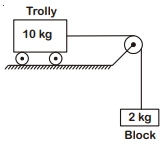
Calculate the acceleration (In $m/s^{2}$) of the block and trolly system shown in the figure. The coefficient of kinetic friction between the trolly and the surface is $0.05 .\left( g =10\; m / s ^{2},\right.$ mass of the string is negligible and no other friction exists).
Fraunhofer lines are produced by
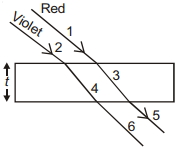
Two parallel rays of red and violet colour passed through a glass slab, which of the following is correct?
If it is assumed that the spinning motion of earth increases, then the weight of a body on equator