MCQ
A ring, a solid sphere and a thin disc of different masses rotate with the same kinetic energy. Equal torques are applied to stop them. Which will make the least number of rotations before coming to rest
  • A
    Disc
  • B
    Ring
  • C
    Solid sphere
  • All will make same number of rotations
Answer

Correct option: D.
All will make same number of rotations
d
As $W = \tau \theta $ = Energy

$⇒$ $\theta  = \frac{{{\rm{Energy}}}}{\tau } = 2n\pi $

So, if energy and torque are same then all the bodies will make same number of rotation.

Need a full question paper?

Generate a complete, print-ready paper with questions like this in minutes — across 16+ boards, with answer keys.

Start Generating Free

Similar questions

$90\%$ of a radioactive sample is left undecayed after time $t$ has elapsed. What percentage of the initial sample will decay in a total time $2t$ : ..............$\%$
A charged particle is released from rest in a region of uniform electric and magnetic fields which are parallel to each other. The particle will move on a
A parallel plate capacitor has a capacitance $\mathrm{C}=200 \mathrm{pF}$. It is connected to $230 \mathrm{~V}$ ac supply with an angular frequency $300 \mathrm{rad} / \mathrm{s}$. The $\mathrm{rms}$ value of conduction current in the circuit and displacement current in the capacitor respectively are :
The value of aluminium susceptibility is $2.2 \times 10^{-5}$. The percentage increase in the magnetic field if space within a current carrying toroid is filled with aluminium is $\frac{x}{10^{4}}$. Then the value of $x$ is ...... .
Which of the following waves can not be polarised ?
Solar energy is incident normally on the earth's surface at the rate of about $1.4 \,kW m m ^{-2}$. The distance between the earth and the sun is $1.5 \times 10^{11} \,m$. Energy $E$ and mass $m$ are related by Einstein equation $E=m c^2$, where $c=3 \times 10^8 \,ms ^{-1}$ is the speed of light in free space. The decrease in the mass of the sun is ........... $\,kg s ^{-1}$
A particle is released from a height $H$. At a certain height its kinetic energy is two times its potential energy. Height and speed of particle at that instant are
A planet of mass is moving around a star of mass $M$ and radius $R$ in a circular orbit of radius $r$. The star abruptly shrinks to half its radius without any loss of mass. What change will be there in the orbit of the planet?
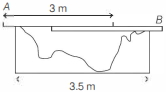
Persons $A$ and $B$ are standing on the opposite sides of a $3.5 \,m$ wide water stream which they wish to cross. Each one of them has a rigid wooden plank whose mass can be neglected. However, each plank is only slightly longer than $3 \,m$. So, they decide to arrange them together as shown in the figure schematically. With $B$ (mass $17 \,kg$ ) standing, the maximum mass of $A$, who can walk over the plank is close to ............ $kg$
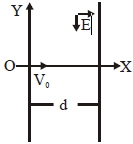
A charged particle (mass $m$ and charge $q$ ) moves along $X$ axis with velocity $V _{0}$. When it passes through the origin it enters a region having uniform electric field $\overrightarrow{ E }=- E \hat{ j }$ which extends upto $x = d$. Equation of path of electron in the region $x > d$ is