MCQ
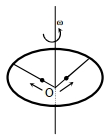
A ring of mass $M$ and radius $R$ is rotating with angular speed $\omega$ about a fixed vertical axis passing through its centre $O$ with two point masses each of mass $\frac{ M }{8}$ at rest at $O$. These masses can move radially outwards along two massless rods fixed on the ring as shown in the figure. At some instant the angular speed of the system is $\frac{8}{9} \omega$ and one of the masses is at a distance of $\frac{3}{5} R$ from $O$. At this instant the distance of the other mass from $O$ is
  • A
    $\frac{2}{3} R$
  • B
    $\frac{1}{3} R$
  • C
    $\frac{3}{5} R$
  • $\frac{4}{5} R$

Answer

Correct option: D.
$\frac{4}{5} R$
d
Using conservation of angular momentum

$mR ^2 \omega=\left(m R^2 \times \frac{8 \omega}{9}\right)+\left(\frac{ m }{8} \times \frac{9 R^2}{25} \times \frac{8 \omega}{9}\right)+\left(\frac{ m }{8} \times x^2 \times \frac{8 \omega}{9}\right) \Rightarrow x=\frac{4 R}{5}$

Need a full question paper?

Generate a complete, print-ready paper with questions like this in minutes — across 16+ boards, with answer keys.

Start Generating Free

Similar questions

The angular velocity and the amplitude of a simple pendulum is $\omega $ and $a$ respectively. At a displacement $X$ from the mean position if its kinetic energy is $T$ and potential energy is $V$, then the ratio of $T$ to $V$ is
Three identical sphere, each of mass $M$ and radius $R$ are placed as shown in figure. Consider an axis $XX'$ which is touching to two sphere and passing through diameter of third shell. Moment of inertia of the system consisting of these three sphere about $XX'$ axis is
$A$ small block of mass $m$ is placed on $a$ wedge of mass $M$ as shown, which is initially at rest. All the surfaces are frictionless . The spring attached to the other end of wedge has force constant $k$. If $a'$ is the acceleration of $m$ relative to the wedge as it starts coming down and $A$ is the acceleration acquired by the wedge as the block starts coming down, then  Maximum retardation of $M$ is:
A cyclist taking turn bends inwards while a car passenger taking same turn is thrown outwards. The reason is
The dimensional formula of Avagadro's number is:
A standing wave $y = A sin \left( {\frac{{20}}{3}\pi \,x} \right) cos (1000\pi t)$ is maintained in a taut string where y and $x$ are expressed in meters. The distance between the successive points oscillating with the amplitude $A/2$ across a node is equal to  ... $cm$
Consider a uniform wire of mass $M$ and length $L$. It is bent into a semicircle. Its moment of inertia about a line perpendicular to the plane of the wire passing through the centre is :
A $5\, m$ long aluminium wire ($Y = 7 \times {10^{10}}N/{m^2})$ of diameter $3\, mm$ supports a $40\, kg$ mass. In order to have the same elongation in a copper wire $(Y = 12 \times {10^{10}}N/{m^2})$ of the same length under the same weight, the diameter should now be, in $mm.$
If $\rho $ is the density of the material of a wire and $\sigma  $ is breaking stress, the greatest length of the wire that can hang freely without breaking is
The particle displacement of a travelling longitudional wave is represented by $\xi  = \xi (x,t)$. The midpoints of a compression zone and an adjacent rarefaction zone are represented by the letter ‘$C’$ and $‘R’$. Which of the following is true?