MCQ
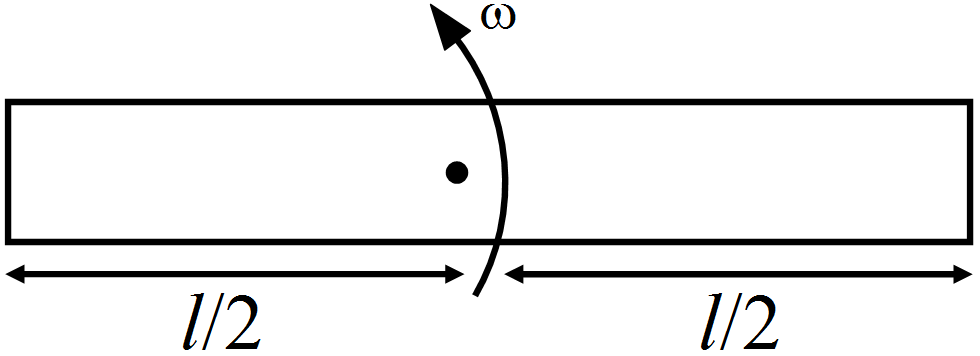
A rod of legth l rotates with a uniform angular velocity $\omega$ about its perpendicular bisector. A uniform magnetic field B exists parallel to the axis of rotation. The potential difference between the two ends of the rod is:
  • $\text{zero}$
  • B
    $\frac{1}{2}\text{Bl}\omega^2$
  • C
    $\text{Bl}\omega ^2$
  • D
    $2\text{B}\text{l}\omega^2$

Answer

Correct option: A.
$\text{zero}$

Emf at both end is same $=\frac{1}{8}\text{Bwl}^2$
So the potential difference between the two ends of therod is zero.

Need a full question paper?

Generate a complete, print-ready paper with questions like this in minutes — across 16+ boards, with answer keys.

Start Generating Free

Similar questions

A thin paper cup filled with water does not catch fire when placed over a flame. This is because
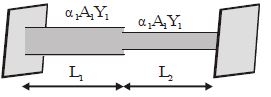
Two rods are joined between fixed supports as shown in the figure. Condition for no change in the lengths of individual rods with the increase of temperature will be

( ${\alpha _1},\,{\alpha _2},$ = linear expansion coefficient

$A_1, A_2$ = Area of rods

$Y_1, Y_2$ = Young modulus)

The moment of inertia of a solid sphere of density $\rho $ and radius R about its diameter is
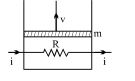
A resistance coil connected to an external battery is placed inside an adiabatic cylinder fitted with a frictionless pistn and containing an ideal gas. A current $i$ flows through the coil which has a resistance $R$. At what speed must the piston move upward in order that the temperature of the gas remains uchanged? Neglect atmospheric pressure. 
The moment of inertia of a ring about one of its diameters is $I.$ What will be its moment of inertia about a tangent parallel to the diameter ?
A particle executes simple harmonic motion with an amplitude of $5\, cm$. When the particle is at $4\, cm$ from the mean position, the magnitude of its velocity is $SI\,units$ is equal to that of its acceleration. Then, its periodic time in seconds is
A man is standing at the centre of frictionless pond of ice. How can he get himself to the shore
The temperature at which the $\text{r.m.s.}$ velocity of $H^2$ becomes escape velocity from the earth is,
A tuning fork vibrating with a sonometer having $20 cm$ wire produces $5$ beats per second. The beat frequency does not change if the length of the wire is changed to $21 cm.$ the frequency of the tuning fork (in Hertz) must be
A string of length $L$ and mass $M$ hangs freely from a fixed point. Then the velocity of transverse waves along the string at a distance $x$ from the free end is