Question
A room is illuminated by an extended source. The illuminance at a particular portion of a wall can be increased by:
  1. Moving the source.
  2. Rotating the source.
  3. Bringing some mirrors in proper positions.
  4. Changing the colour of the source.

Answer

  1. Moving the source.
  2. Rotating the source.
  3. Bringing some mirrors in proper positions.
  4. Changing the colour of the source.
Explanation:
  1. Moving the source to the middle will illuminate the surface properly because illuminance depends upon the distance from the source.
  2. Rotating the source will also have an effect because illuminance depends upon the angle made by the normal on the surface.
  3. Bringing mirrors to the proper position will increase illuminance at that particular portion of the wall by gathering light and focussing them at one point.
  4. Our eyes sense some colours as bright and some colours as dull, selecting the colours near yellow will make the wall appear brighter.

Need a full question paper?

Generate a complete, print-ready paper with questions like this in minutes — across 16+ boards, with answer keys.

Start Generating Free

Similar questions

For the harmonic travelling wave $\text{y}=2\cos2\pi(10\text{t}-0.0080\text{x}+3.5)$ where x and y are in cm and t is second. What is the phase difference between the oscillatory motion at two points separated by a distance of:0.5m
A simple pendulum is mounted inside a space craft. What should be its time period of oscillation?
Fundamental frequency of oscillation of a close pipe is 400Hz. What will be the fundamental frequency of oscillation of an open pipe of same length?
When the reaction of the supporting surface is zero then apparent weight of the body become equal to _________.
Two exactly similar simple pendula are vibrating with amplitudes 1cm and 3cm. What is the ratio of their energies of vibration?
Light from a point source falls on a screen. If the separation between the source and the screen is increased by $1\%$, the illuminance will decrease $($nearly$)$ by:
If all the particle of a system lie in a cube, is it neccesary that the centre of mass be in the cube?
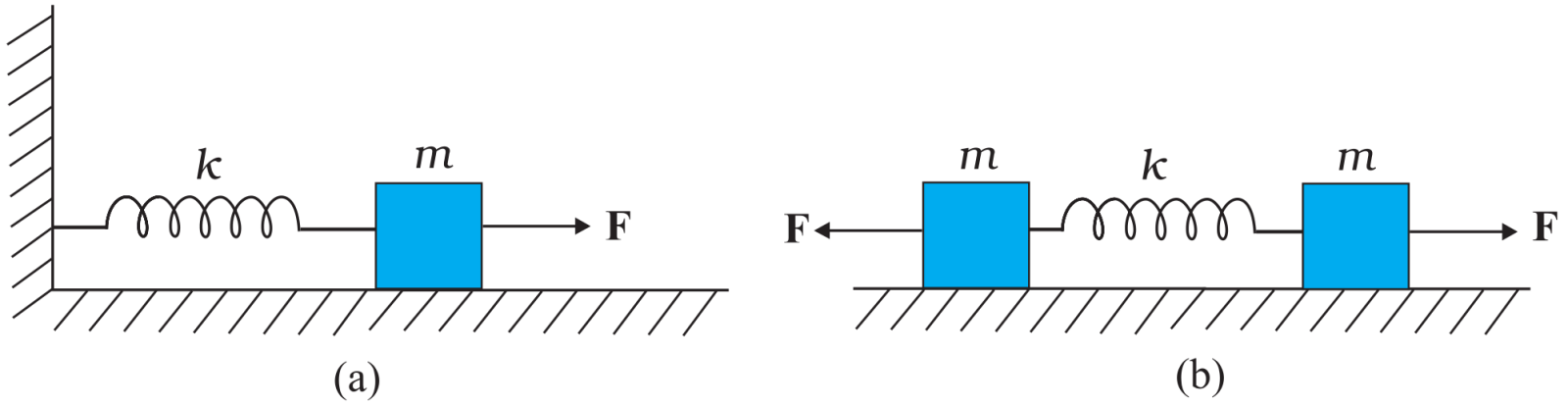
Figure (a) shows a spring of force constant k clamped rigidly at one end and a mass m attached to its free end. A force F applied at the free end stretches the spring. Figure (b) shows the same spring with both ends free and attached to a mass m at either end. Each end of the spring in Fig. (b) is stretched by the same force F.
What is the maximum extension of the spring in the two cases?
When a p-type impurity is doped in a semiconductor, a large number of holes are created. This does not make the semiconductor charged. But when holes diffluse from the p-side to the n-side in a p-n junction, the n-side gets positively charged. Explain.
Mention the law of equal division of energy.