A rubber cord catapult has cross-sectional area $25\,m{m^2}$ and initial length of rubber cord is $10\,cm.$ It is stretched to $5\,cm.$ and then released to project a missile of mass $5gm.$ Taking ${Y_{rubber}} = 5 \times {10^8}N/{m^2}$ velocity of projected missile is ......... $ms^{-1}$
Diffcult
Download our app for free and get started
(c) Potential energy stored in the rubber cord catapult will be converted into kinetic energy of mass.
$\frac{1}{2}m{v^2} = \frac{1}{2}\frac{{YA{l^2}}}{L}$ $\Rightarrow $ $v = \sqrt {\frac{{YA{l^2}}}{{mL}}} $
$ = \sqrt {\frac{{5 \times {{10}^8} \times 25 \times {{10}^{ - 6}} \times {{(5 \times {{10}^{ - 2}})}^2}}}{{5 \times {{10}^{ - 3}} \times 10 \times {{10}^{ - 2}}}}} = 250\;m/s$

Download our appand get started for free
Experience the future of education. Simply download our apps or reach out to us for more information. Let's shape the future of learning together!No signup needed.*
Similar Questions
- 1A steel wire is $1 \,m$ long and $1 \,mm ^2$ in area of cross-section. If it takes $200 \,N$ to stretch this wire by $1 \,mm$, how much force will be required to stretch a wire of the same material as well as diameter from its normal length of $10 \,m$ to a length of $1002 \,cm$ is ........ $N$View Solution
- 2A glass slab is subjected to a pressure of $10\, atm$. The fractional change in its volume is (Bulk modulus of glass $= 37 \times 10^9\, N\, m^{-2}$, $1\, atm = 1 \times 10^5\, N\, m^{-2}$)View Solution
- 3What must be the lengths of steel and copper rods at $0^o C$ for the difference in their lengths to be $10\,cm$ at any common temperature? $(\alpha_{steel}=1.2 \times {10^{-5}} \;^o C^{-1})$ and $(\alpha_{copper} = 1.8 \times 10^{-5} \;^o C^{-1})$View Solution
- 4Consider two wires of same material having their ratio of radii to be $2: 1$. If these two wires are stretched by equal force, then the ratio of stress produced in them isView Solution
- 5Join details of Column$-II$ with given information in Column$-I$ appropriatelyView Solution
Column $-I$ Column $-II$ $(a)$ Stress is proportional to strain.
$(i)$ Elastic limit $(b)$ When the load of the wire is removed, the body does regain its original dimension. $(ii)$ Limit of pro-portionality $(iii)$ Plastic deformation - 6A meter scale of mass $m$ , Young modulus $Y$ and cross section area $A$ is hanged vertically from ceiling at zero mark. Then separation between $30\ cm$ and $70\ cm$ mark will be :-( $\frac{{mg}}{{AY}}$ is dimensionless)View Solution
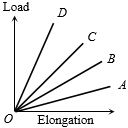
- 7View SolutionThe load versus elongation graph for four wires of the same material is shown in the figure. The thickest wire is represented by the line
- 8A rigid bar of mass $15\,kg$ is supported symmetrically by three wire each of $2 \,m$ long. These at each end are of copper and middle one is of steel. Young's modulus of elasticity for copper and steel are $110 \times 10^9 \,N / m ^2$ and $190 \times 10^9 \,N / m ^2$ respectively. If each wire is to have same tension, ratio of their diameters will be $ ............$View Solution
- 9When a pressure of $100$ atmosphere is applied on a spherical ball, then its volume reduces to $0.01\%$. The bulk modulus of the material of the rubber in $dyne/c{m^2}$ isView Solution
- 10The diagram shows stress v/s strain curve for the materials $A$ and $B$. From the curves we infer thatView Solution