A sample of metal weighs $210 gm$ in air, $180 gm$ in water and $120 gm$ in liquid. Then relative density $(RD) $ of
Diffcult


Download our appand get started for free
Experience the future of education. Simply download our apps or reach out to us for more information. Let's shape the future of learning together!No signup needed.*
Similar Questions
- 1A small metal sphere of radius $a$ is falling with a velocity $v$ through a vertical column of a viscous liquid. If the coefficient of viscosity of the liquid is $\eta $ , then the sphere encounters an opposing force ofView Solution
- 2A long cylindrical vessel is half filled with a liquid. When the vessel is rotated about its own vertical axis, the liquid rises up near the wall. If the radius of vessel is $5\,cm$ and its rotational speed is $2$ rotations per second, then the difference in the heights between the centre and the sides, in $cm,$ will beView Solution
- 3Two bodies are in equilibrium when suspended in water from the arms of a balance. The mass of one body is $36 g $ and its density is $9 g / cm^3$. If the mass of the other is $48 g$, its density in $g / cm^3$ isView Solution
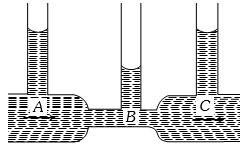
- 4In the following fig. is shown the flow of liquid through a horizontal pipe. Three tubes $A, B$ and $ C$ are connected to the pipe. The radii of the tubes $A, B $ and $C$ at the junction are respectively $ 2 cm, 1 cm$ and $2 cm.$ It can be said that theView Solution
- 5Water flows in a stream line manner through a capillary tube of radius $a$. The pressure difference being $P$ and the rate of flow is $Q$. If the radius is reduced to $\frac{a}{4}$ and the pressure is increased to $4 P$. then the rate of flow becomes ................View Solution
- 6A pressure-pump has a horizontal tube of cross-sectional area $10\,cm ^{2}$ for the outflow of water at a speed of $20\,m / s$. The force exerted on the vertical wall just in front of the tube which stops water horizontally flowing out of the tube, is $...N$ [given : density of water $=1000\,kg / m ^{3}$ ]View Solution
- 7View SolutionScent sprayer is based on
- 8A liquid is flowing in a horizontal uniform capillary tube under a constant pressure difference $P$. The value of pressure for which the rate of flow of the liquid is doubled when the radius and length both are doubled isView Solution
- 9A beaker is filled in with water is accelerated $a $ $m/s^2$ in $+x$ direction. The surface of water shall make on angleView Solution
- 10At what speed, the velocity head of water is equal to pressure head of $40 \,cm$ of mercury is ........ $m / s$View Solution