MCQ
A satellite of mass $\mathrm{m}$ is launched vertically upwards with an initial speed $u$ from the surface of the earth. After it reaches height $\mathrm{R}$ ($R =$ radius of the earth), it ejects a rocket of mass $\frac{\mathrm{m}}{10}$ so that subsequently the satellite moves in a circular orbit. The kinetic energy of the rocket is

($G$ is the gravitational constant: $\mathrm{M}$ is the mass of the earth)

  • A
    $\frac{\mathrm{m}}{20}\left(\mathrm{u}-\sqrt{\frac{2 \mathrm{GM}}{3 \mathrm{R}}}\right)^{2}$
  • $5 \mathrm{m}\left(\mathrm{u}^{2}-\frac{119}{200} \frac{\mathrm{GM}}{\mathrm{R}}\right)$
  • C
    $\frac{3 m}{8}\left(u+\sqrt{\frac{5 G M}{6 R}}\right)^{2}$
  • D
    $\frac{m}{20}\left(u^{2}+\frac{113}{200} \frac{G M}{R}\right)$
Answer

Correct option: B.
$5 \mathrm{m}\left(\mathrm{u}^{2}-\frac{119}{200} \frac{\mathrm{GM}}{\mathrm{R}}\right)$
b
Applying energy conservation

Applying energy conservation

${\mathrm{K}_{1}+\mathrm{U}_{\mathrm{i}}=\mathrm{K}_{\mathrm{f}}+\mathrm{U}_{\mathrm{f}}}$

${\frac{1}{2} \mathrm{mu}^{2}+\left(-\frac{\mathrm{GMm}}{\mathrm{R}}\right)=\frac{1}{2} \mathrm{mv}^{2}-\frac{\mathrm{GMm}}{2 \mathrm{R}}}$

$\mathrm{v}=\sqrt{\mathrm{u}^{2}-\frac{\mathrm{GM}}{\mathrm{R}}}$

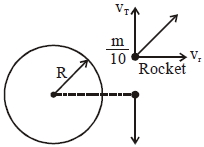
By momentum conservation, we have

$\frac{\mathrm{m}}{10} \mathrm{v}_{\mathrm{T}}=\frac{9 \mathrm{m}}{10} \sqrt{\frac{\mathrm{GM}}{2 \mathrm{R}}}$

and $\frac{\mathrm{m}}{10} \mathrm{v}_{\mathrm{r}}=\mathrm{mv}$

$\Rightarrow \frac{\mathrm{m}}{10} \mathrm{v}_{\mathrm{r}}=\mathrm{m} \sqrt{\mathrm{u}^{2}-\frac{\mathrm{GM}}{\mathrm{R}}}$

Kinetic energy of rocket

${=\frac{1}{2} \mathrm{m}\left(\mathrm{v}_{\mathrm{T}}^{2}+\mathrm{v}_{\mathrm{r}}^{2}\right)}$

${=\frac{\mathrm{m}}{20}\left(81 \frac{\mathrm{GM}}{2 \mathrm{R}}+100 \mathrm{u}^{2}-100 \frac{\mathrm{GM}}{\mathrm{R}}\right)}$

${=\frac{\mathrm{m}}{20}\left(100 \mathrm{u}^{2}-\frac{119 \mathrm{GM}}{2 \mathrm{R}}\right)}$

${=5 \mathrm{m}\left(\mathrm{u}^{2}-\frac{119 \mathrm{GM}}{200 \mathrm{R}}\right)}$

Need a full question paper?

Generate a complete, print-ready paper with questions like this in minutes — across 16+ boards, with answer keys.

Start Generating Free

Similar questions

Which of the following graphs correctly represents the variation of $\beta = - (dV/dP)/V$ with $P$ for an ideal gas at constant temperature
A lift is moving downwards with an acceleration equal to acceleration due to gravity. $A$ body of mass $M$ kept on the floor of the lift is pulled horizontally. If the coefficient of friction is $\mu $, if the lift is moving upwards with a uniform velocity, then the frictional resistance offered by the body is
A boggy of uniformly moving train is suddenly detached from train and stops after covering some distance. The distance covered by the boggy and distance covered by the train in the same time has relation
........ $N$  the maximum force for which both the block will move with same acceleration.
Three copper blocks of masses $M_1, M_2$ and $M_3\ kg$ respectively are brought into thermal contact till they reach equilibrium. Before contact, they were at $T_1, T_2, T_3 (T_1 > T_2 > T_3).$ Assuming there is no heat loss to the surroundings, the equilibrium temprature $T$ is $(s$ is specific heat of copper$)$
A body of mass $4 \mathrm{~kg}$ experiences two forces $\overrightarrow{\mathrm{F}}_1=5 \hat{\mathrm{i}}+8 \hat{\mathrm{j}}+7 \hat{\mathrm{k}}$ and $\overrightarrow{\mathrm{F}}_2=3 \hat{\mathrm{i}}-4 \hat{\mathrm{j}}-3 \hat{\mathrm{k}}$. The acceleration acting on the body is :
If $\gamma $ denotes the ratio of two specific heats of a gas, the ratio of slopes of adiabatic and isothermal $PV$ curves at their point of intersection is
A large nonconducting sheet M is given a uniform charge density. Two uncharged small metal rods A and B are placed near the sheet as shown in figure:
A particle is moving along a vertical circle of radius $R$. At $P$, what will be the velocity of particle (assume critical condition at $C)$ ?
Which of the following factors affect the thermal conductivity of a rod?