MCQ
A satellite of mass $m$ revolves around the earth of radius $R$ at a height $x$ from it's surface. If $g$ is the acceleration due to gravity on the surface of earth, the orbital speed of
  • A
    $gx$
  • B
    ${\left( {\frac{{gR}}{{R - x}}} \right)^{1/2}}$
  • ${\left( {\frac{{gR^2}}{{R + x}}} \right)^{1/2}}$
  • D
    ${\left( {\frac{{gR}}{{R + x}}} \right)^{1/2}}$
Answer

Correct option: C.
${\left( {\frac{{gR^2}}{{R + x}}} \right)^{1/2}}$
c
${v_0} = \sqrt {\frac{{Gm}}{{R + x}}}  = {\left( {\frac{{g{R^2}}}{{R + x}}} \right)^{1/2}}$

Need a full question paper?

Generate a complete, print-ready paper with questions like this in minutes — across 16+ boards, with answer keys.

Start Generating Free

Similar questions

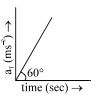
Tangential acceleration of a particle moving in a circle of radius $1$ $m$ varies with time $t$ as (initial velocity of particle is zero). Time after which total acceleration of particle makes and angle of $30^o$ with radial acceleration is
A tangent galvanometer is connected directly to an ideal battery. If the number of turns in the coil is doubled the deflection will:
$Assertion :$ The heat supplied to a system is always equal to the increase in its internal energy.
$Reason :$ When a system changes from one thermal equilibrium to another, some heat is absorbed by it.
The dimension of the ratio of angular to linear momentum is
In a two dimensional motion, instantaneous speed $\text{v}_0$ is a positive constant. Then which of the following are necessarily true?
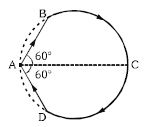
Consider a circle of radius $42\  cm$. An insect crawls with uniform speed of $1.3\  cm/s$ along the chord $AB$ then along the circular arc $BCD$ to reach point $D$ and then following cord $DA$ to reach finally $A$. Time spend by the insect to crawl from $A$ to $A$ is closest to    ......... $\sec$
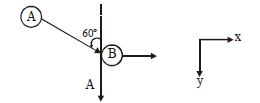
Ball $A$ moving at $12\  m/s$ collides elastically with $B$ as shown. If both balls have the same mass, what is the final velocity of ball $A$ ? ................$m/s$
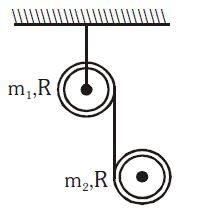
In the given figure linear acceleration of solid cylinder of mass $m_2$ is $a_2$. Then angular acceleration $\alpha_2$ is (given that there is no slipping).
Two particles of the same mass are moving in circular orbits because of force, given by $F(r) = \frac{{ - 16}}{r}\, - \,{r^3}$ The first particle is at a distance $r = 1,$  and the second, at $r = 4.$  The best estimate for the ratio of kinetic energies of the first and the second particle is closest to
A point particle is acted upon by a restoring force $-k x^{3}$. The time-period of oscillation is $T$, when the amplitude is $A$. The time-period for an amplitude $2 A$ will be