- Must be less than 10cm.
- Must be greater than 20cm.
- Must not be greater than 20cm.
- Must not be less than 10cm.
Explanation:
$\text{v}=(40-4)$
$\frac{1}{\text{f}}=\frac{1}{40-4}-\frac{1}{(-\text{u})}$
$\frac{\text{df}}{\text{du}}=0$ for f minimum.
$\frac{\text{df}}{\text{du}}=1-\frac{\text{u}}{20}=0$
$\text{u}=20$
$\text{f}_{\text{min}}=10\text{cm}$
Generate a complete, print-ready paper with questions like this in minutes — across 16+ boards, with answer keys.
According to Maxwell’s hypothesis, a changing electric field gives rise to
|
(a) An e.m.f. |
(b) Electric current |
(c) Magnetic field |
(d) Pressure radiant |
Assertion : Photosensitivity of a metal is high if its work function is small.
Reason : Work function =
where
is the threshold frequency.
|
(a) If both assertion and reason are true and the reason is the correct explanation of the assertion. |
|
(b) If both assertion and reason are true but reason is not the correct explanation of the assertion. |
|
(c) If assertion is true but reason is false. |
|
(d) If the assertion and reason both are false. |
An important spectral emission line has a wavelength of 21 cm. The corresponding photon energy is (h = 6.62 ![]()
|
(a) 5.9 |
(b) 5.9 |
(c) 5.9 |
(d) 11.8 |
In short wave communication waves of which of the following frequencies will be reflected back by the ionospheric layer, having electron density 1011 per m3
|
(a) 2 MHz |
(b) 10 MHz |
(c) 12 MHz |
(d) 18 MHz |
The SI unit of inductance, the henry, can be written as
|
(a) Weber/ampere |
(b) Volt-second/ampere |
(c) Joule/(ampere)2 |
(d) a, b, c |
The plates of a parallel plate capacitor of capacity 50 μC are charged to a potential of 100 volts and then separated from each other so that the distance between them is doubled. How much is the energy spent in doing so
|
(a) 25 |
(b) -12.5 |
(c) -25 |
(d) 12.5 |
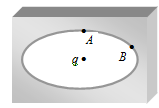
An ellipsoidal cavity is carved within a perfect conductor. A positive charge q is placed at the centre of the cavity. The points A and B are on the cavity surface as shown in the figure. Then

|
(a) Potential at A = Potential at B |
|
(b) Total electric field flux through the surface of the cavity is q/ |
|
(c) Electric field near A in the cavity = Electric field near B in the cavity |
|
(d) a, b |