MCQ
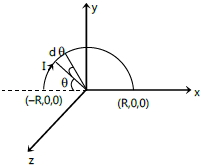
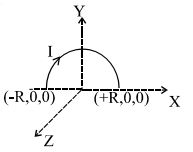
A semi circular current carrying wire having radius $R$ is placed in $x-y$ plane with its centre at origin $‘O’$. There is non-uniform magnetic $\vec B = \frac{{{B_o}x}}{{2R}}\hat k$ (here $B_o$ is + $ve$ constant) is existing in the region. The  magnetic force acting on semi circular wire will be along
  • $- x-axis$
  • B
    $+ y-axis$
  • C
    $- y-axis$
  • D
    $+ x-axis$

Answer

Correct option: A.
$- x-axis$
a
$\mathrm{F}=\mathrm{I} \int \mathrm{R} \mathrm{d} \theta(\sin \theta \hat{\mathrm{i}}+\cos \theta \hat{\mathrm{j}}) \times \frac{\mathrm{B}_{0}}{2 \mathrm{R}}(-\mathrm{R} \cos \theta) \hat{\mathrm{k}}$

$=\frac{I B_{0} R}{2} \int_{0}^{\pi}(\sin \theta \hat{i}+\cos \theta \hat{j}) x(-\cos \theta \hat{k}) d \theta$

$=\int_{0}^{\pi}\left(\sin \theta \cos \theta \hat{j}-\cos ^{2} \theta \hat{i}\right) d \theta$

$=\int_{0}^{\pi}\left(\frac{\sin 2 \theta \hat{j}}{2}-\frac{(1+\cos 2 \theta) \hat{i}}{2}\right) d \theta$

$=\left[\frac{-\cos 2 \theta}{4}\right]_{0}^{\pi} \hat{j}-\left[\frac{\theta}{2}\right]_{0}^{\pi} \hat{i}-\left[\frac{\sin 2 \theta}{4}\right]_{0}^{\pi} \hat{i}$

$=0-(\pi / 2) \hat i-0=-(\pi / 2) \hat i$

Need a full question paper?

Generate a complete, print-ready paper with questions like this in minutes — across 16+ boards, with answer keys.

Start Generating Free

Similar questions

By opening the door of a refrigerator placed inside a room you
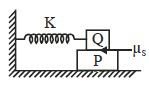
A block $P$ of mass $m$ is placed on a smooth horizontal surface. A block $Q$ of same mass is placed over the block $P$ and the coefficient of static friction between them is ${\mu _S}$. A spring of spring constant $K$ is attached to block $Q$. The blocks are displaced together to a distance $A$ and released. The upper block oscillates without slipping over the lower block. The maximum frictional force between the block is
When a body is thrown with a velocity $u$ making an angle $\theta $ with the horizontal plane, the maximum distance covered by it in horizontal direction is
Light from a hydrogen discharge tube is incident on the cathode of a photoelectric cell the work function of the cathode surface is $4.2\ eV$. In order to reduce the photo-current to zero the voltage of the anode relative to the cathode must be made ........... $V$
Which one of the following forces cannot be expressed in terms of potential energy?
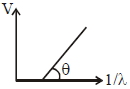
In a photoelectric effect experiment, the graph of stopping potential $V$ versus reciprocal of wavelength obtained is shown in the figure. As the intensity of incident radiation is increased
A vessel contains $1$ mole of ${O_2}$ gas (molar mass $32)$ at a temperature $T.$ The pressure of the gas is $P. $ An identical vessel containing one mole of $He$ gas (molar mass $4)$ at temperature $2T$ has a pressure of
Magnitude of vector which comes on addition of two vectors, $6\hat i + 7\hat j$ and $3\hat i + 4\hat j$ is
A litre of dry air at $STP$ expands adiabatically to a volume of $3$ litres. If $\gamma=1.40,$ the work done by air is$(3^{1.4}=4.6555)$ [Take air to be an ideal gas $]$
The displacement $x$ (in metres) of a particle performing simple harmonic motion is related to time $t$ (in seconds) as $x = 0.05\cos \left( {4\,\pi \,t + \frac{\pi }{4}} \right)$. The frequency of the motion will be ..... $Hz$