Question
A semiconductor has equal electron and hole concentration of 2 × 10⁸/m3. On doping with a certain impurity, the hole concentration increases to 4 × 10¹⁰/m3.
  1. What type of semiconductor is obtained on doping?
  2. Calculate the new electron and hole concentration of the semiconductor.
  3. How does the energy gap vary with doping?

Answer

Given ne = 2 × 10⁸/m3, nh = 4 × 10¹⁰/m3

  1. The majority charge carriers in doped semiconductor are holes, so semiconductor obtained is p-type semiconductor.

$\text{n}_\text{e}\text{n}_h=\text{n}^2_\text{i}$

$\Rightarrow\text{n}_\text{h}=\frac{\text{n}^2_\text{i}}{\text{n}_\text{h}}$

$=\frac{(2\times10^8)^2}{4\times10^{10}}=10^6/\text{m}^3$

  1. New electron concentration = 106/m3

Hole concentration = 4 × 1010/m3

  1. Energy gap decreases on doping.

Need a full question paper?

Generate a complete, print-ready paper with questions like this in minutes — across 16+ boards, with answer keys.

Start Generating Free

Similar questions

A table with smooth horizontal surface is placed in a cabin which moves in a circle of a large radius R (figure In). A smooth pulley of small radius is fastened to the table. Two masses m and 2m placed on the table are connected through a string going over the pulley. Initially the masses are held by a person with the strings along the outward radius and then the system is released from rest (with respect to the cabin). Find the magnitude of the initial acceleration of the masses as seen from the cabin and the tension in the string.

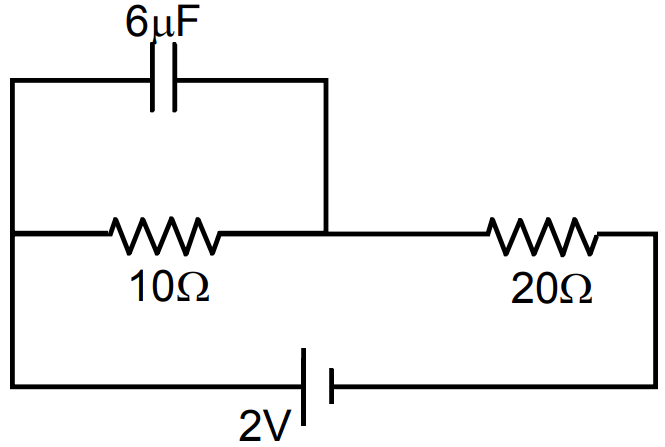
Find the charge on the capacitor shown in figure.

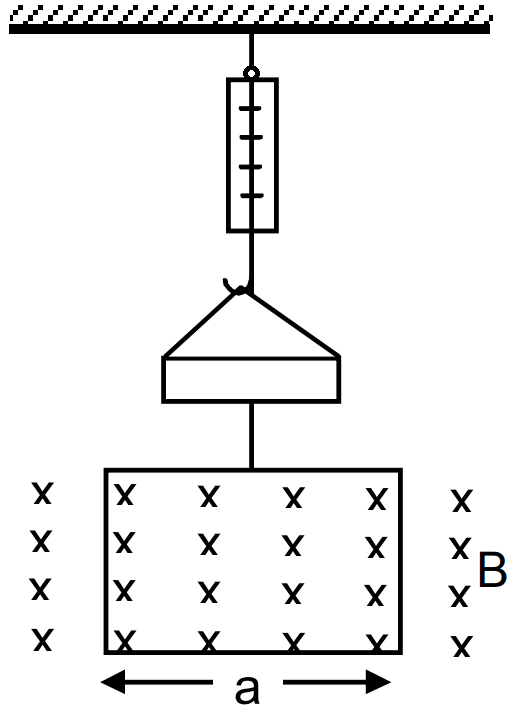
A rectangular wire loop of width a is suspended from the insulated pan of a spring balance, as shown in A current i exists in the anti-clockwise direction in the loop. A magnetic field Bexists in the lower region. Find the change in the tension of the spring if the current in the loop is reversed.

Find the radius of gyration of a circular ring of radius r about a line perpendicular to the plane of the ring and passing through one of its particles.
An object P is focused by a microscope M. A glass slab of thickness 2.1cm is introduced between P and M. If the refractive index of the slab is 1.5, by what distance should the microscope be shifted to focus the object again?
Write the mathematical relation for the resistivity of a material in terms of relaxation time, number density and mass and charge of charge carriers in it. Explain, using this relation, why the resistivity of a metal increases and that of a semi-conductor decreases with rise in temperature.
  1. Draw a neat labelled ray diagram of an astronomical telescope in normal adjustment. Explain briefly its working.
  2. An astronomical telescope uses two lenses of powers 10 D and 1 D. What is its magnifying power in normal adjustment?
A beam of light converges at a point P. Now a lens is placed in the path of the convergent beam 12cm from P. At what point does the beam converge if the lens is (a) a convex lens of focal length 20cm, and (b) a concave lens of focal length 16cm?
If mercury and glass had equal coefficient of volume expansion, could we make a mercury thermometer in a glass tube?
A electron of mass me revolves around a nucleus of charge +Ze. Show that it behaves like a tiny magnetic dipole. Hence prove that the magnetic moment associated wit it is expressed as $\vec\mu=-_{e2{\text{ me}}}\overrightarrow{\text{L}}$, where $\overrightarrow{\text{L}}$ is the orbital angular momentum of the electron. Give the significance of negative sign.