Question
A semiconductor has equal electron and hole concentration of $2 \times 10^8/m^3$. On doping with a certain impurity, the hole concentration increases to $4 × 10^{10}/m^3.$
  1. What type of semiconductor is obtained on doping?
  2. Calculate the new electron and hole concentration of the semiconductor.
  3. How does the energy gap vary with doping?
Answer

Given $n_e = 2 \times 10^8/m^3, n_h = 4 \times 10^{10}/m^3$
  1. The majority charge carriers in doped semiconductor are holes, so semiconductor obtained is p-type semiconductor.
$\text{n}_\text{e}\text{n}_h=\text{n}^2_\text{i}$
$\Rightarrow\text{n}_\text{h}=\frac{\text{n}^2_\text{i}}{\text{n}_\text{h}}$
$=\frac{(2\times10^8)^2}{4\times10^{10}}=10^6/\text{m}^3$
  1. New electron concentration $= 10^6/m^3$
Hole concentration $= 4 \times 10^{10}/m^3$
  1. Energy gap decreases on doping.

Need a full question paper?

Generate a complete, print-ready paper with questions like this in minutes — across 16+ boards, with answer keys.

Start Generating Free

Similar questions

Is it easier to take out a nucleon from carbon or from iron? Fi-om iron or from lead?
i. What characteristic property of nuclear force explains the constancy of binding energy per nucleon (BE/A) in the range of mass number $A$ lying $30<A<170$ ?
ii. Show that the density of nucleus over a wide range of nuclei is constant and independent of mass number A

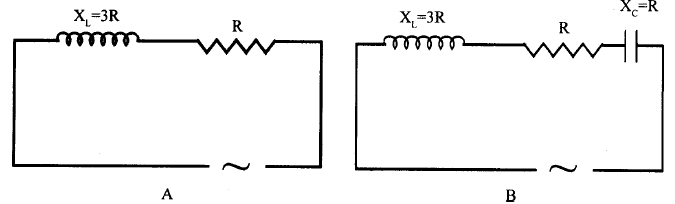
Given below are two electric circuits A and B.

Calculate the ratio of power factor of the circuit B to the power factor of circuit A.
Find the ratio of the lengths of an iron rod and an aluminium rod for which the difference in the lengths is independent of temperature. Coefficients of linear expansion of iron and aluminium are ${12 \times 10^{-6}}  ^\circ C^{-1}$ and ${23 \times 10^{-6}}^\circ C^{-1}$ respectively.
State briefly the underlying principle of a transistor oscillator. Draw a circuit diagram showing how the feedback is accomplished by inductive coupling. Explain the oscillator action.
Obtain the de Broglie wavelength associated with thermal neutrons at room temperature (27ºC). Hence explain why a fast neutron beam needs to be thermalised with the environment before it can be used for neutron diffraction experiments.
Define polarization.
A charge of $20\mu\text{C}$ is placed on the positive plate of an isolated parallel-plate capacitor of capacitance $10\mu\text{F}.$ Calculate the potential difference developed between the plates.
The near vision of an average person is 25cm. To view an object with an angular magnification of 10, what should be the power of the microscope?
A certain sample of a radioactive material decays at the rate of 500 per second at a certain time. The count rate falls to 200 per second after 50 minutes.
  1. What is the decay constant of the sample?
  2. What is its half-life?