MCQ
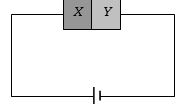
A semiconductor $X$ is made by doping a germanium crystal with arsenic $(Z = 33)$. $A$ second semiconductor $Y$ is made by doping germanium with indium $(Z = 49)$. The two are joined end to end and connected to a battery as shown. Which of the following statements is correct
  • A
    $X$ is $P-$type, $Y$ is $N-$type and the junction is forward biased
  • B
    $X$ is $N-$type, $Y$ is $P-$type and the junction is forward biased
  • C
    $X$ is $P-$type, $Y$ is $N-$type and the junction is reverse biased
  • $X $ is $N-$type, $Y$ is $P-$type and the junction is reverse biased

Answer

Correct option: D.
$X $ is $N-$type, $Y$ is $P-$type and the junction is reverse biased
d
(d)Arsenic has five valence electrons, so it a donor impurity. Hence $X$ becomes $N-$type semiconductor. Indium has only three outer electrons, so it is an acceptor impurity. Hence $Y$ becomes $P-$ type semiconductor. Also $N$ $(i.e.\, X)$ is connected to positive terminal of battery and $P(i.e\, Y)$ is connected to negative terminal of battery so $PN-$junction is reverse biased.

Need a full question paper?

Generate a complete, print-ready paper with questions like this in minutes — across 16+ boards, with answer keys.

Start Generating Free

Similar questions

Two identical particles of mass $1\, {kg}$ each go round a circle of radius ${R}$, under the action of their mutual gravitational attraction. The angular speed of each particle is :
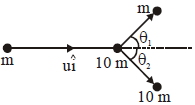
A particle of mass $m$ is moving along the $x$ -axis with initial velocity $u \hat i$. It collides elastically with a particle of mass $10\, m$ at rest and then moves with half its initial kinetic energy (see figure). If $\sin \theta_{1}=\sqrt{n} \sin \theta_{2}$ then value of $n$ is.....
A thin-walled, spherical conducting shell $S$ of radius $R$ is given charge $Q$. The same amount of charge is also placed at its centre $C. $ Which of the following statements are correct ? 
The maximum number of possible interference maxima for slit separation equal to $1.8\,\lambda $, where $\lambda $ is the wavelength of light used, in a Young's double slit experiment is
The filament of a light bulb has surface area $64 mm ^2$. The filament can be considered as a black body at temperature $2500 K$ emitting radiation like a point source when viewed from far. At night the light bulb is observed from a distance of $100 m$. Assume the pupil of the eyes of the observer to be circular with radius $3 mm$. Then

(Take Stefan-Boltzmann constant $=5.67 \times 10^{-8} Wm ^{-2} K ^{-4}$, Wien's displacement constant $=2.90 \times 10^{-3} m - K$, Planck's constant $=6.63 \times 10^{-34} Js$, speed of light in vacuum $=3.00 \times 10^8 ms ^{-1}$ )-

$(A)$ power radiated by the filament is in the range $642 W$ to $645 W$

$(B)$ radiated power entering into one eye of the observer is in the range $3.15 \times 10^{-8} W$ to $3.25 \times 10^{-8} W$

$(C)$ the wavelength corresponding to the maximum intensity of light is $1160 nm$

$(D)$ taking the average wavelength of emitted radiation to be $1740 nm$, the total number of photons entering per second into one eye of the observer is in the range $2.75 \times 10^{11}$ to $2.85 \times 10^{11}$

Two trains are moving with equal speed in opposite directions along two parallel railway tracks. If the wind is blowing with speed $u$ along the track so that the relative velocities of the trains with respect to the wind are in the ratio of $1:2$, then the speed of each train must be
Transverse wave propagates in a medium with a velocity of $1450\,m/s$ . The distance between the nearest points at which the oscillations of the particles carried in the opposite phase $\pi $ is $0.1\,m$ . What is the frequency of the wave ..... $Hz$ ?
With a potentiometer null point were obtained at $140\, cm$ and $180\, cm$ with cells of $emf$ $1.1 \,V$ and one unknown $X\, volts$. Unknown $emf$ is .............. $V$
Four mole of hydrogen, two mole of helium and one mole of water vapour form an ideal gas mixture. What is the molar specific heat at constant pressure of mixture?
A point particle is held on the axis of a ring of mass $m$ and radius $r$ at a distance $r$ from its centre $C$. When released, it reaches $C$ under the gravitational attraction of the ring. Its speed at $C$ will be