-
$\text{3V}\cos\theta$
-
$2\text{V}\cos\theta$
-
$\frac{3}{2}\text{V}\cos\theta$
-
$\text{V}\cos\theta$
$\text{3V}\cos\theta$
$2\text{V}\cos\theta$
$\frac{3}{2}\text{V}\cos\theta$
$\text{V}\cos\theta$
Explanation:
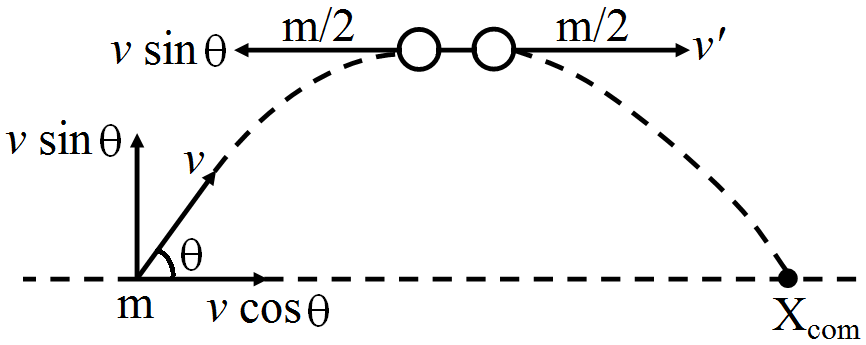
The linear momentum is conserved in horizontal direction.

Initial momentum = Final momentum
$\Rightarrow\text{mv}\cos\theta=-\frac{\text{m}}{2}\text{v}\cos\theta+\frac{\text{m}}{2}\text{v}'$
$\Rightarrow\text{v}'=\text{mv}\cos\theta$
Generate a complete, print-ready paper with questions like this in minutes — across 16+ boards, with answer keys.
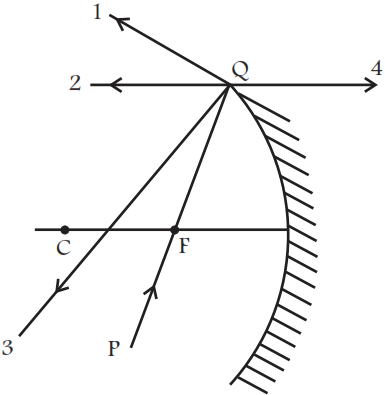
The direction of ray of light incident on a concave mirror is shown by PQ while directions in which the ray would travel after reflection is shown by four rays marked 1, 2, 3 and 4 (Fig). Which of the four rays correctly shows the direction of reflected ray?

When light is incident on a doubly refracting crystal, two refracted rays-ordinary ray (O-ray) and extra ordinary ray (E-ray) are produced. Then
|
(a) Both O-ray and E-ray are polarised perpendicular to the plane of incidence |
|
(b) Both O-ray and E-ray are polarised in the plane of incidence |
|
(c) E-ray is polarised perpendicular to the plane of incidence and O-ray in the plane of incidence |
|
(d) E-ray is polarised in the plane of incidence and O-ray perpendicular to the plane of incidence |
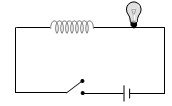
In the following circuit, the bulb will become suddenly bright if

|
(a) Contact is made or broken |
(b) Contact is made |
|
(c) Contact is broken |
(d) Won't become bright at all |
In the Bohr's hydrogen atom model, the radius of the stationary orbit is directly proportional to (n = principle quantum number)
|
(a) |
(b) n |
(c) |
(d) |
The process of superimposing signal frequency (i.e. audio wave) on the carrier wave is known as
|
(a) Transmission |
(b) Reception |
(c) Modulation |
(d) Detection |
An electric dipole is put in north-south direction in a sphere filled with water. Which statement is correct
|
(a) Electric flux is coming towards sphere |
|
(b) Electric flux is coming out of sphere |
|
(c) Electric flux entering into sphere and leaving the sphere are same |
|
(d) Water does not permit electric flux to enter into sphere |
The first excited state of hydrogen atom is 10.2 eV above its ground state. The temperature is needed to excite hydrogen atoms to first excited level, is
|
(a) 7.9 |
(b) 3.5 |
(c) 5.8 |
(d) 14 |
When NPN transistor is used as an amplifier
|
(a) Electrons move from base to emitter |
|
(b) Electrons move from emitter to base |
|
(c) Electrons moves from base to emitter |
|
(d) Holes moves from base to emitter |