- A$\frac{2 v_1^2 v_2}{g}$
- B$\frac{2 v_1^2}{g}$
- C$\frac{2 v_2^2}{g}$
- ✓$\frac{2 v_1 v_2}{g}$
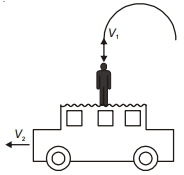
There is no acceleration in the horizontal direction.
$S_x=U_x T+\frac{1}{2} a_0 \times T^2$
$R=U_x T \ldots (1)$
$S_y=U_y T+\frac{1}{2} g_y T^2$
$O=V_1 T-\frac{1}{2} g T^2$
$\Rightarrow V_1 T=\frac{1}{2} g T$
$T=\frac{2 V_1}{g}$
We know,
$(R)$ range $=($ Horizontal velocity $4 x) \times$ flight $+$ time $(T)$
i.e., $R=4 x \times T$
$R=V_2 \times \frac{2 V_1}{g} \Rightarrow \frac{2 V_1 V_2}{g}$
Generate a complete, print-ready paper with questions like this in minutes — across 16+ boards, with answer keys.
$B = 100 \times {10^{ - 6}}\,\sin \,\left[ {2\pi \times 2 \times {{10}^{15}}\,\left( {t - \frac{x}{c}} \right)} \right]$
then the maximum electric field associated with it is

[Given: Wien's constant as $2.9 \times 10^{-3} \mathrm{~m}-\mathrm{K}$ and $\frac{\mathrm{hc}}{\mathrm{e}}=1.24 \times 10^{-6} \mathrm{~V}-\mathrm{m}$ ]
| List-$I$ | List-$II$ |
| ($P$) $2000 \mathrm{~K}$ | ($1$) The radiation at peak wavelength can lead to emission of photoelectrons from a metal of work function $4 \mathrm{eV}$ |
| ($Q$) $3000 \mathrm{~K}$ | ($2$) The radiation at peak wavelength is visible to human eye. |
| ($R$) $5000 \mathrm{~K}$ | ($3$) The radiation at peak emission wavelength will result in the widest central maximum of a single slit diffraction. |
| ($S$) $10000 \mathrm{~K}$ | ($4$) The power emitted per unit area is $1 / 16$ of that emitted by a blackbody at temperature $6000 \mathrm{~K}$. |
| ($5$) The radiation at peak emission wavelength can be used to image human bones. |