MCQ
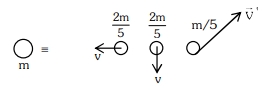
A shell of mass $m$ is at rest initially. It explodes into three fragments having mass in the ratio $2: 2: 1$. If the fragments having equal mass fly off along mutually perpendicular directions with speed $v$, the speed of the third (lighter) fragment is :
  • A
    $\sqrt{2} v$
  • $2 \sqrt{2} v$
  • C
    $3 \sqrt{2} v$
  • D
    $v$

Answer

Correct option: B.
$2 \sqrt{2} v$
b
By conservation of momentum :

$m(0)=\frac{2 m}{5}(-v \hat{i})+\frac{2 m}{5}(-v \hat{j})+\frac{m}{5} \vec{v}^{\prime}$

$\Rightarrow \vec{v}^{\prime}=2 v \hat{i}+2 v \hat{j}$

$\Rightarrow v^{\prime}=\sqrt{(2 v)^{2}+(2 v)^{2}}$

$=2 \sqrt{2} v$

Need a full question paper?

Generate a complete, print-ready paper with questions like this in minutes — across 16+ boards, with answer keys.

Start Generating Free

Similar questions

In figure, two blocks $M$ and $m$ are tied together with an inextensible and light string. The mass $M$ is placed on a rough horizontal surface with coefficient of friction $\mu$ and the mass $m$ is hanging vertically against a smooth vertical wall. The pulley is frictionless. Choose the correct statement $(s)$
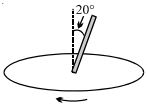
$A$ uniform rod is fixed to a rotating turntable so that its lower end is on the axis of the turntable and it makes an angle of $20^o$ to the vertical. (The rod is thus rotating with uniform angular velocity about a vertical axis passing through one end.) If the turntable is rotating clockwise as seen from above. What is the direction of the rod's angular momentum vector (calculated about its lower end)?
A particle moves with a velocity $\vec v\, = \,5\hat i - 3\hat j + 6\hat k\,\,m/s$ under the influence of a constant force $\vec F\, = \,10\hat i + 10\hat j + 20\hat k$. Instantaenous power will be ............... $J/s$
The ratio of angular speeds of minute hand and hour hand of a watch is
The centre of mass of a system of particles is at the origin. It follows that:
  1. The number of particles to the right of the origin is equal to the number of particles to the left.
  2. The total mass of the particles to the right of the origin is same as the total mass to the left of the origin.
  3. The number of particles on X-axis should be equal to the number of particles on Y-axis.
  4. If there is a particle on the positive X-axis, there must be at least one particle on the negative X-axis.
  5. None.
A mixture of $2\, moles$ of helium gas (atomic mass $= 4\, u$), and $1\, mole$ of argon gas (atomic mass $= 40\, u$) is kept at $300\, K$ in a container. The ratio of their rms speeds $\left[ {\frac{{{V_{rms}}{\rm{(helium)}}}}{{{V_{rms}}{\rm{(argon)}}}}} \right]$, is close to
If the potential energy between two molecules is given by $U =\frac{-A }{ r ^{6}}+\frac{ B }{ r ^{12}},$ then at equilibrium, separation between molecules, and the potential energy are
The motion of a particle as per $x=Asin \omega t + Bcos\omega t$ is :-
Which one of the following equations of motion represents simple harmonic motion ? 

Where $k,k_0,k_1$ and $a$ are all positive

A vertical mass-spring system executes simple harmonic oscillations with a period of $2\,s$. A quantity of this system which exhibits simple harmonic variation with a period of $1\, s$ is