Question
A short bar magnet placed in a horizontal plane has its axis aligned along the magnetic north-sourth direction. Null points are found on the axis of the magnet at 14 cm from the centre of the magnet. The earth's magnetic field at the place is 0.36 G and the angle of dip is zero. What is the total magnetic field on the normal bisector of the magnet at the same distance as the null points (i.e. 14 cm) from the centre of the magnet? (at null points, field due to a magnet is equal and opposite to the horizontal component of earth's magnetic field).
Answer

As null points are on the axis of the magnet, therefore,
$B_1=\frac{\mu_0}{4 \pi} \frac{2 M}{d^3}=H$
On the equatorial line of magnet at same direction (d), field due to the magnet is
$B_2=\frac{\mu_0}{4 \pi} \frac{M}{d^3}=\frac{B_1}{2}=\frac{H}{2}$
$\therefore$ Total magnetic field at this point on equatorial line
$B = H + B _2= H +\frac{ H }{2}$
$=\frac{3}{2} H =\frac{3}{2} \times 0.36=0.54 G$

Need a full question paper?

Generate a complete, print-ready paper with questions like this in minutes — across 16+ boards, with answer keys.

Start Generating Free

Similar questions

At what rate should the earth rotate so that the apparent g at the equator becomes zero? What will be the length of the day in this situation?
The amount of electric charge passing through a cross-section of wire in time t is Q (t) = At2 + Bt + C
Where A, B and C are constants having values 5, 4 and 1 respectively.
Calculate the value of electric current at t = 4s.
Let $\vec{\text{a}}=2\vec{\text{i}}+3\vec{\text{j}}+4\vec{\text{k}}$ and $\vec{\text{b}}=3\vec{\text{i}}+4\vec{\text{j}}+5\vec{\text{k}}.$ Find the angle between them.
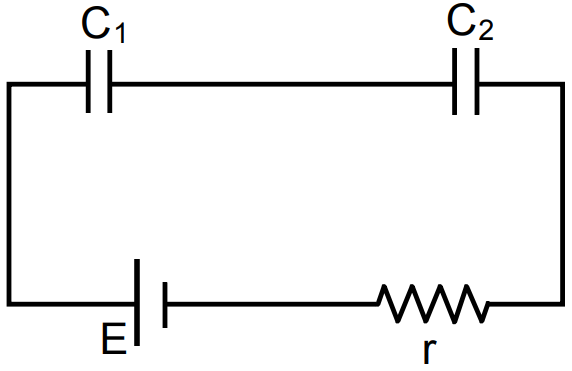
Consider the situation shown in figure. The switch is closed at t = 0 when the capacitors are uncharged. Find the charge on the capacitor C1 as a function of time t.

The dimensions of an atom are of the order of an Angstrom. Thus there must be large electric fields between the protons and electrons. Why, then is the electrostatic field inside a conductor zero?
Consider an ice cube of edge 1.0cm kept in a gravity free hall. Find the surface area of the water when the ice melts. Neglect the difference in densities of ice and water.
A 30.0cm long wire having a mass of 10.0g is fixed at the two ends and is vibrated in its fundamental mode. A 50.0cm long closed organ pipe, placed with its open end near the wire, is set up into resonance in its fundamental mode by the vibrating wire. Find the tension in the wire. Speed of sound in air = 340m/s.
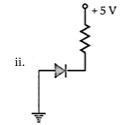
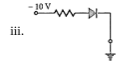
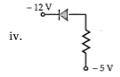
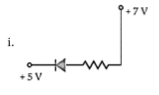
In the following diagrams indicate which of the diodes are forward biased and which are reverse biased.
Image
Image
Image
Image
Describe the two shortcomings of Bohr model of atom.
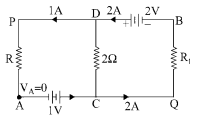
In the given figure, point A is at zero potential. Use Kirchhoff's rules to find out the potential at B.
Image