Question
A short magnet makes 40 oscillations per minute when used in an oscillation magnetometer at a place where the earth's horizontal magnetic field is $2\mu\text{T.}$ Another short magnet of magnetic moment $1.6A-m^2$ is placed 20cm east of the oscillating magnet. Find the new frequency of oscillation if the magnet has its north pole:
  1. Towards north.
  2. Towards south.

Answer

$\gamma_1=40$ oscillations/ minute$\text{B}_\text{H}=25\mu\text{T}$
m of second magnet = $1.6A-m^2$
d = 20cm = 0.2m
For north facing north
$\gamma_1=\frac{1}{2\pi}\sqrt{\frac{\text{MB}_{\text{H}}}{\text{I}}}$
$\gamma_2=\frac{1}{2\pi}\sqrt{\frac{\text{M}(\text{B}_{\text{H}}-\text{B})}{\text{I}}}$
$\text{B}=\frac{\mu_0}{4\pi}\frac{\text{m}}{\text{d}^3}=\frac{10^{-7}\times1.6}{8\times10^{-3}}=20\mu\text{T}$
$\frac{\gamma_1}{\gamma_2}=\sqrt{\frac{\text{B}}{\text{B}_{\text{H}-\text{B}}}}\Rightarrow\frac{40}{\gamma_2}=\sqrt{\frac{25}{5}}\Rightarrow\gamma_2=\frac{40}{\sqrt{5}}$
$=17.88\approx18\text{ osci/min}$
For north pole facing south
$\gamma_1=\frac{1}{2\pi}\sqrt{\frac{\text{MB}_{\text{H}}}{\text{I}}}$
$\gamma_2=\frac{1}{2\pi}\sqrt{\frac{\text{M}(\text{B}_{\text{H}}-\text{B})}{\text{I}}}$
$\frac{\gamma_1}{\gamma_2}=\sqrt{\frac{\text{B}}{\text{B}_{\text{H}-\text{B}}}}\Rightarrow\frac{40}{\gamma_2}=\sqrt{\frac{25}{45}}\Rightarrow\gamma_2=\frac{40}{\sqrt{\Big(\frac{25}{45}\Big)}}$
$=53.66\approx54\text{ osci/min}$

Need a full question paper?

Generate a complete, print-ready paper with questions like this in minutes — across 16+ boards, with answer keys.

Start Generating Free

Similar questions

The mean free path of electrons in a gas in a discharge tube is inversely proportional to the pressure inside it. The Crookes dark space occupies half the length of the discharge tube when the pressure is 0.02mm of mercury. Estimate the pressure at which the dark space will fill the whole tube.
Read the passage given below and answer the following questions from $1$ to $5.$ Friction: Let us return to the example of a body of mass m at rest on a horizontal table. The force of gravity $(mg)$ is cancelled by the normal reaction force $(N)$ of the table. Now suppose a force F is applied horizontally to the body. We know from experience that a small applied force may not be enough to move the body. But if the applied force F were the only external force on the body, it must move with acceleration F/m, however small. Clearly, the body remains at rest because some other force comes into play in the horizontal direction and opposes the applied force F, resulting in zero net force on the body. This force fs parallel to the surface of the body in contact with the table is known as frictional force, or simply friction. When there is no applied force, there is no static friction. It comes into play the moment there is an applied force. As the applied force $F$ increases, fs also increases, remaining equal and opposite to the applied force $($up to a certain limit$),$ keeping the body at rest. Hence, it is called static friction. Static friction opposes impending motion. The term impending motion means motion that would take place $($but does not actually take place$)$ under the applied force, if friction were absent. It is found experimentally that the limiting value of static friction $(fs )$ max f is independent of the area of contact and varies with the normal force$(N)$ approximately as: $(\text{f}_{\text{s}})\text{max}=\mu\text{N}$ where μs is a constant of proportionality depending only on the nature of the surfaces in contact. The constant μs is called the coefficient of static friction. The law of static friction may thus be written as $(\text{f}_{\text{s}})\leq\mu\text{sN}$ Frictional force that opposes relative motion between surfaces in contact is called kinetic or sliding friction and is denoted by $fk$. Kinetic friction, like static friction, is found to be independent of the area of contact. Further, it is nearly independent of the velocity. It satisfies a law similar to that for static friction: $(\text{f}_{\text{k}})=\mu_{\text{k}}\text{N}$
  1. Force of static friction is directly proportional to:
  1. Normal reaction
  2. Force by gravity
  3. Velocity of body
  4. None of these
  1. Coefficient of kinetic friction is independent of area of contact. True or false?
  1. True
  2. False
  1. Give formula for law of static friction
  1. Explain law of static friction
  1. Explain kinetic friction.
A discharge tube contains helium at low pressure. A large potential difference is applied across the tube. Consider a helium atom that has just been ionised due to the detachment of an atomic electron. Find the ratio of the distance travelled by the free electron to that by the positive ion in a short time dt after ionisation.
Read the passage given below and answer the following questions from 1 to 5.
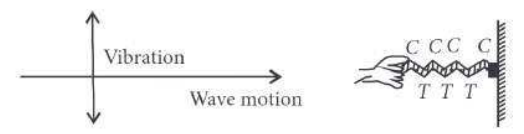
Transverse and Longitudinal Waves Transverse waves forms if the particles of the medium vibrate at right angle to the direction of wave motion energy propagation, the wave is called transverse wave. These are propagated as crests and troughs.

Longitudinal waves forms if the particles of the medium vibrate in the direction of wave motion, the wave is called longitudinal. These are propagated as compressions and rarefactions and wave is also known as pressure or compressional wave. Wave on spring or sound waves in air are examples of longitudinal waves.
  1. In a transverse wave, the particles of the medium:
  1. Vibrate in a direction perpendicular to the direction of the propagation.
  2. Vibrate in a direction parallel to the direction of the propagation.
  3. Move in circle.
  4. Move in ellipse.
  1. A transverse wave consists of:
  1. Only crests
  2. Only troughs
  3. Both crests and troughs
  4. Rarefactions and compressions
  1. Ultrasonic waves produced by a vibrating quartz crystal are:
  1. Only longitudinal.
  2. Only transverse.
  3. Both longitudinal and transverse.
  4. Neither longitudinal nor transverse.
  1. Sound waves travel fastest in:
  1. Solids
  2. Liquids
  3. Gases
  4. Vacuum
  1. Sound waves in air cannot be polarized because:
  1. Their speed is small
  2. They require medium
  3. They are longitudinal
  4. Their speed is temperature dependent
A magnetic dipole of magnetic moment $1.44A-m^2$ is placed horizontally with the north pole pointing towards north. Find the position of the neutral point if the horizontal component of the earth's magnetic field is $18 \mu\text{T}.$
Read the passage given below and answer the following questions from 1 to 5.Following are properties of vectors
a) Two vectors A and B are said to be equal if, and only if, they have the same magnitude and the same direction.
b) Multiplying a vector A with a positive number λ gives a vector whose magnitude is changed by the factor λ but the direction is the same as that of A:
$|\ \lambda\text{ A }|=\lambda\text{ A }|$
c) The null vector also results when we multiply a vector A by the number zero. Properties of 0 are
A + 0 = A
λ 0 = 0
0 A = 0
d) Subtraction of vectors can be defined in terms of addition of vectors. We define the difference of two vectors A and B as the sum of two vectors A and –B :
A – B = A + (–B).
  1. Two vectors A and B are said to be equal if:
  1. they have the same magnitude
  2. they have the same direction
  3. they have the same magnitude and the same direction
  4. None of these
  1. Multiplying a vector A with a positive number will impact:
  1. Change in magnitude
  2. Change in direction
  3. Change in both magnitude and the same direction
  4. None of these
  1. What is null vector?
  1. How we can perform subtraction of two vectors?
  1. Enlist any 4 properties of vectors.
Read the passage given below and answer the following questions from (i) to (v). Momentum and Newton’s Second Law of Motion Momentum of a body is the quantity of motion possessed by the body. It depends on the mass of the body and the velocity with which it moves. When a bullet is fired by a gun, it can easily pierce human tissue before coming to rest resulting in casualty. The same bullet fired with moderate speed will not cause much damage. The greater the change in momentum in a given time, the greater is the force that needs to be applied. The second law of motion refers to the general situation, where there is a net external force rating on the body.
  1. A satellite in force-free space sweeps stationary interplanetary dust at a rate $\frac{\text{dM}}{\text{dt}}=\text{dv,}$ where M is the mass, v is the dt velocity of satellite and a is a constant. What is the deceleration of the satellite?
  1. $\frac{-2\text{av}^2}{\text{M}}$
  2. $\frac{-\text{av}^2}{\text{M}}$
  3. $\text{-av}^2$
  4. $\frac{\text{av}^2}{\text{M}}$
  1. A body of mass 5 kg is moving with velocity of $\text{v} = (2\hat{\text{i}} + 6\hat{\text{j}}) ms^{-1}$ at t = 0s. After time t = 2s, velocity of body is $(10\hat{\text{i}} + 6\hat{\text{j}}) ms^{-1},$ then change in momentum of body is:
  1. $40\hat{\text{i}}\text{ kg}-\text{ms}^{-1}$
  2. $20\hat{\text{i}}\text{ kg}-\text{ms}^{-1}$
  3. $30\hat{\text{i}} \text{kg}-\text{ms}^{-1}$
  4. $(50\hat{\text{i}}+30\hat{\text{j}})\text{ Kg - ms}^{-1}$
  1. A cricket ball of mass 0.25kg with speed 10m/ s collides with a bat and returns with same speed with in 0.01s. The force acted on bat is:
  1. 25N
  2. 50N
  3. 250N
  4. 500N
  1. A stationary bomb explodes into three pieces. One piece of 2 kg mass moves with a velocity of 8 ms” 1 at right angles to the other piece of mass 1 kg moving with a velocity of 12 ms -1 . If the mass of the third piece is 0.5 kg, then its velocity is:
  1. $10ms^{-1}$
  2. $20ms^{-1}$
  3. $30ms^{-1}$
  4. $AOms^{-1}$
  1. A force of 10 N acts on a body of mass 0.5kg for 0.25s starting from rest. What is its momentum now?
  1. 0.25 N/ s
  2. 2.5 N/ s
  3. 0.5 N/ s
  4. 0.75 N/ s
A steel blade placed gently on the surface of water floats on it. If the same blade is kept well inside the water, it sinks. Explain.
Two blocks of unequal masses are tied by a spring. The blocks are pulled stretching the spring slightly and the system is released on a frictionless horizontal platform. Are the forces due to the spring on the two blocks equal and opposite? If yes, is it an example of Newton's third law?
A closed bottle contains some liquid. The bottle is shaken vigorously for 5 minutes. It is found that the temperature of the liquid is increased. Is heat transferred to the liquid? Is work done on the liquid? Neglect expansion on heating.