Question

A short sighted person can see distinctly only those objects which lie between 10 cm and 100 cm from him. The power of the spectacle lens required to see a distant object is

(a) + 0.5 D

(b) – 1.0 D

(c)  – 10 D

(d)  + 4.0 D

Answer

(b) – 1.0 D

Need a full question paper?

Generate a complete, print-ready paper with questions like this in minutes — across 16+ boards, with answer keys.

Start Generating Free

Similar questions

Large transformers, when used for some time, become hot and are cooled by circulating oil. The heating of transformer is due to

(a) Heating effect of current alone

(b) Hysteresis loss alone

(c) Both the hysteresis loss and heating effect of current

(d) None of the above

If the electric force between two unknown charges is attractive, identify which of the following statement must be true?

In an adjoining figure are shown three capacitors   and   joined to a battery. The correct condition will be (Symbols have their usual meanings)

(a)  and  

(b)  and  

(c)  and  

(d)   and  

The output of OR gate is 1:

Carbon, silicon and Germanium atoms have four valence electrons each. Their valence and conduction band are separated by energy band gaps represented by (Eg)C. (Eg)Si and (Eg)Ge respectively. Which one of the following relationship is true in their case

(a) ( 

(b)  

(c) 

(d)  

Which of the following is not the unit of self inductance

(a) Weber/Ampere

(b) Ohm-Second

(c) Joule-Ampere

(d) Joule Ampere–2

An electron is moving with an initial velocity $\text{v}=\text{v}_0\hat{\text{i}}$ and is in a magnetic field $\text{B}=\text{B}_0\hat{\text{j}}$. Then it's de Broglie wavelength:
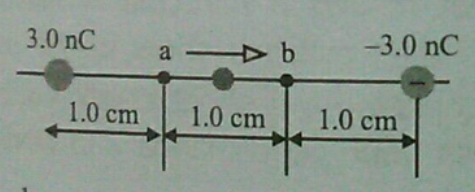
As shown in figure a dust particle with mass m = 5.0 × 10⁻⁹ kg and charge q= 2.0nC starts from rest at point a and moves in a straight line to point b. What is its speed v at point b?

A bar magnet is cut into two equal halves by a plane parallel to the magnetic axis. Of the following physical quantities the one which remains unchanged is:

Rutherford’s a - particle experiment showed that the atoms have

(a) Proton

(b) Nucleus

(c) Neutron

(d) Electrons