Question
A simple microscope has a magnifying power of $3.0$ when the image is formed at the near point $(25\ cm)$ of a normal eye.
  1. What is its focal length?
  2. What will be its magnifying power if the image is formed at infinity?
Answer

The simple microscope has, $m = 3,$ when image is formed at $D = 25\ cm$
  1. $\text{m}=1+\frac{\text{D}}{\text{f}}\Rightarrow3=1+\frac{25}{\text{f}}$
$\Rightarrow\text{f}=\frac{25}{2}=12.5\text{cm}$
  1. When the image is formed at infinity $($normal adjustment$)$
Magnifying power $=\frac{\text{D}}{\text{f}}=\frac{25}{12.5}= 2.0$

Need a full question paper?

Generate a complete, print-ready paper with questions like this in minutes — across 16+ boards, with answer keys.

Start Generating Free

Similar questions

A hiker stands on the edge of a cliff $490 m$ above the ground and throws a stone horizontally with an initial speed of $15\ m s ^{-1}$. Neglecting air resistance, find the time taken by the stone to reach the ground, and the speed with which it hits the ground. $($Take $g=9.8\ m s ^{-2} ).$
State law of equi-partition of energy. Use this law to calculate specific heats of monoatomic, diatomic and triatomic gases.
Water drops fall freely from a tap at a height of $4.9m$. If time interval between successive drops is equal and the $4th$ drop is released when the first lands on the ground, find the separation between the second and third drops.
A charge of $+2.0 \times 10^{-8}C$ is placed on the positive plate and a charge of $-1.0 \times 10^{-8}C$ on the negative plate of a parallel-plate capacitor of capacitance $1.2\times10^{-3}\mu\text{F}.$ Calculate the potential difference developed between the plates.
A helicopter of mass $500\ kg$ rises with a vertical acceleration of $10ms ^{-2}$. The weight of pilot is $60\ kg$. Give the magnitude and direction of :
  1. force on the floor of the helicopter by the pilot
  2. action of the rotor of the helicopter on the surrounding air
  3. force on the helicopter due to the surrounding air.
$($Take $g = 10 ms^{-2}).$
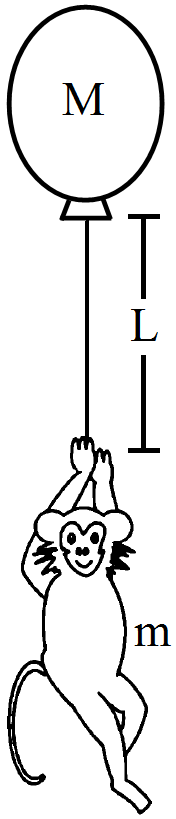
The balloon, the light rope and the monkey shown in figure are at rest in the air. If the monkey reaches the top of the rope, by what distance does the balloon descend ? Mass of the balloon = M, mass of the monkey = m and the length of the rope ascended by the monkey = L.
A projectile is thrown at an angle of 60° with the horizontal. After how much time will its inclination with the horizontal be 45°? [Given $|\vec{\text{v}}|=147\text{ m/s}]$
Find an expression for the orbital velocity of a satellite revolving around the earth in a circular orbit at a height h above the surface of earth.
There are energy bands in a solid. Do we have really continuous energy variation in a band or do we have very closely spaced but still discrete energy levels?
We have valence electrons and conduction electrons in a semiconductor. Do we also have 'valence holes' and 'conduction holes'?