MCQ
A simple microscope has:
  • A
    $2$ convex lens
  • B
    $2$ concave lens
  • $1$ convex lens
  • D
    $1$ concave lens

Answer

Correct option: C.
$1$ convex lens

A simple microscope is made up of a single convex lens fitted in a round metallic frame with a handle.

Need a full question paper?

Generate a complete, print-ready paper with questions like this in minutes — across 16+ boards, with answer keys.
Start Generating Free

Similar questions

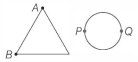
A uniform metallic wire of length $L$ is mounted in two configurations. In configuration $1$ (triangle), it is an equilateral triangle and a voltage $V$ is applied to corners $A$ and $B$. In configuration $2$ (circle), it is bent in the form of a circle and the potential $V$ is applied at diametrically opposite points $P$ and $Q$. The ratio of the power dissipated in configuration $1$ to configuration $2$ is
In forward bias, the width of potential barrier in a P-N junction diode
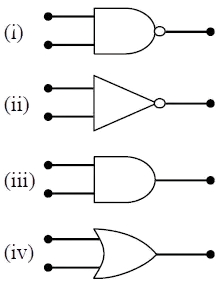
The symbolic representation of four logic gates are given below

The logic symbols for $OR, NOT$ and $NAND$ gates are respectively 
An $e.m.f.$ of $5$ $volt$ is produced by a self inductance, when the current changes at a steady rate from $3\, A$ to $2 \,A$ in $1$ millisecond. The value of self inductance is
A metallic ring of radius $a$ and resistance $R$ is held fixed with its axis along a spatially uniform magnetic field whose magnitude is $B_0 \sin \omega t$. Gravity is neglected. Then,
Which of the following is not an application of eddy currents
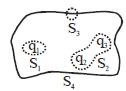
Three charges $q_1 = 1\,\mu c, q_2 = 2\,\mu c$ and $q_3 = -3\,\mu c$ and four surfaces $S_1, S_2 ,S_3$ and $S_4$ are shown in figure. The flux emerging through surface $S_2$ in $N-m^2/C$ is
Which represents $NAND$ gate a
A particle $A$ has charge $ + q$ and a particle $B$ has charge $ + \,4q$ with each of them having the same mass $m$. When allowed to fall from rest through the same electric potential difference, the ratio of their speed $\frac{{{v_A}}}{{{v_B}}}$ will become
Which of the following statement is false for the properties of electromagnetic waves ?