Question
A simple microscope using a single lens often shows coloured image of a white source. Why?

Answer

A simple microscope consists of a single convex lens. Sometimes due to chromatic and spherical aberrations, the image of a white source seems coloured at the corners of the lens and somewhere in between.

Need a full question paper?

Generate a complete, print-ready paper with questions like this in minutes — across 16+ boards, with answer keys.
Start Generating Free

Similar questions

A thin spherical shell of radius R lying on a rough horizontal surface is hit sharply and horizontally by a cue. Where should it be hit so that the shell does not slip on the surface?
  1. Find the first excitation potential of $\mathrm{He}^{+}$ion.
  2. Find the ionization potential of $\mathrm{Li}^{++}$ion.
Distinguish between 'intrinsic' and 'extrinsic' semiconductors.
A person can hear sound waves in the frequency range 20Hz to 20kHz. Find the minimum and the maximum wavelengths of sound that is audible to the person. The speed of sound is 360m/s.
Draw a plot of the binding energy per nucleon as a function of mass number for a large number of nuclei, 2⩽ A⩽240. How do you explain the constancy of binding energy per nucleon in the range 30 < A < 170 using the property that nuclear force is short - ranged?
Two spheres A and B with radii $a$ and $b$ respectively are at the same potential. What will be the ratio of surface charge densities at $A$ and $B$ ?
Find the intensity at a point on a screen in Young’s double slit experiment where the interfering waves have a path difference of (i) $\lambda/6$, and (ii) $\lambda/2.$
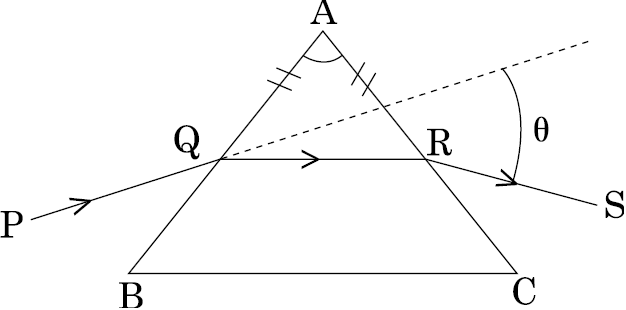
A ray PQ incident on the refracting face BA is refracted in the prism BAC as shown in the figure and emerges from the other refracting face AC as RS such that AQ = AR. If the angle of prism $A = 60^\circ$ and refractive index of material of prism is$\sqrt{3}$, calculate angle $\theta.$
A spherical conducting shell of inner radius $r_1$ and outer radius $r_2$ has a charge ‘Q’. A charge ‘q’ is placed at the centre of the shell.
  1. What is the surface charge density on the (i) inner surface, (ii) outer surface of the shell?
  2. Write the expression for the electric field at a point $x > r_2$ from the centre of the shell.
The coil of a moving-coil galvanometer keeps on oscillating for a long time if it is deflected and released. If the ends of the coil are connected together, the oscillation stops at once. Explain