Question
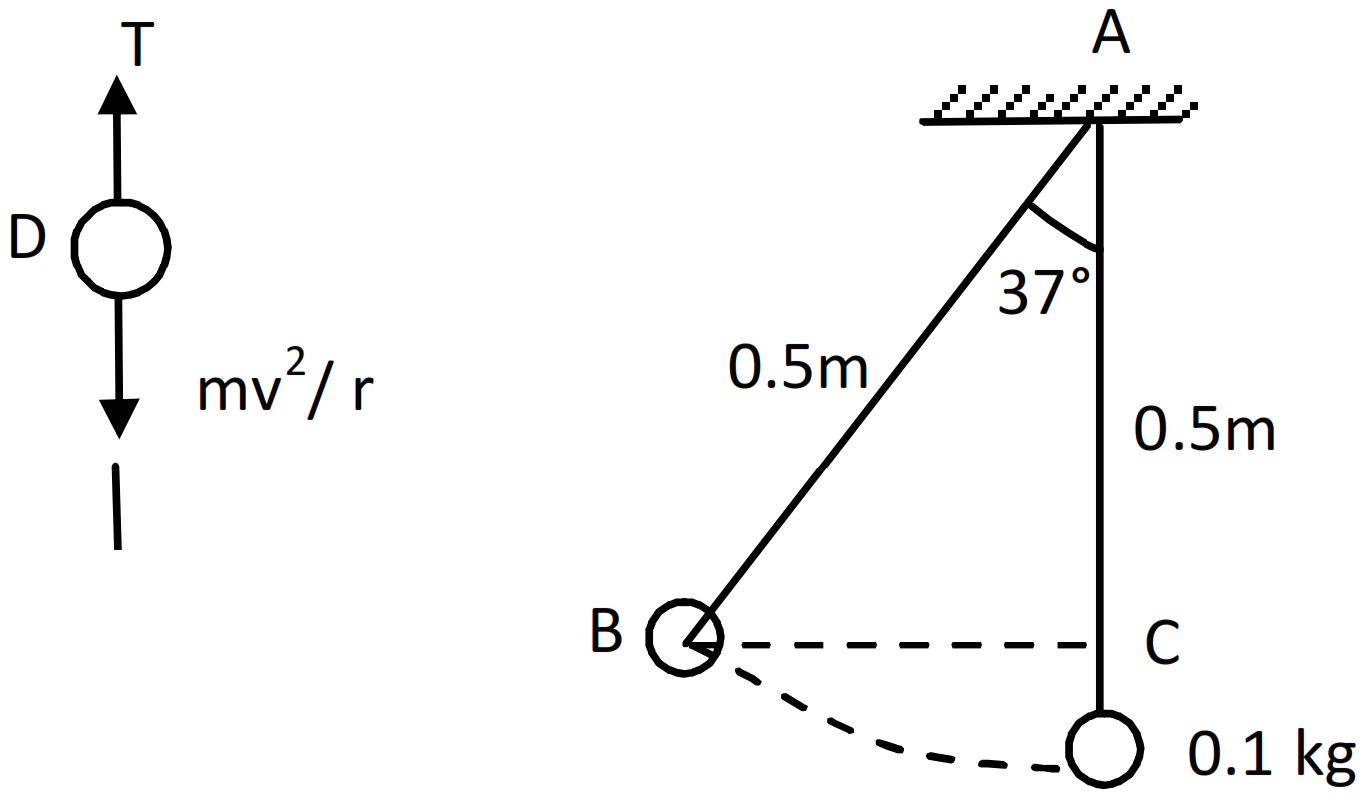
A simple pendulum consists of a 50cm long string connected to a 100g ball. The ball is pulled aside so that the string makes an angle of 37° with the vertical and is then released. Find the tension in the string when the bob is at its lowest position.
Answer

From the figure, $\cos\theta=\frac{\text{AC}}{\text{AB}}$
$\Rightarrow\text{AC}=\text{AB}\cos\theta$ $\Rightarrow(0.5)\times(0.8)=0.4$ So, CD = (0.5) - (0.4) = (0.1)m Energy at D = energy at B $\frac{1}{2}\text{mv}^2=\text{mg}(\text{CD})$ $\text{v}^2=2\times10\times(0.1)=2$ So, the tension is given by, $\text{T}=\frac{\text{mv}^2}{\text{r}}+\text{mg}$ $\Rightarrow(0.1)\Big(\frac{2}{0.5}+10\Big)=1.4\text{N}$

Need a full question paper?

Generate a complete, print-ready paper with questions like this in minutes — across 16+ boards, with answer keys.

Start Generating Free

Similar questions

A U-tube contains water and methylated spirit separated by mercury. The mercury columns in the two arms are in level with $10.0cm$ of water in one arm and $12.5cm$ of spirit in the other. What is the specific gravity of spirit?
  1. If the successive overtones of vibrating string are $280Hz$ and $350Hz$, what is the frequency of the fundamental note?
  2. If the amplitude of a sound wave is tripled, by how many $dB$ will the intensity level increases?
A cylinder of fixed capacity contains $44.8L$ of helium gas at STP. Calculate the amount of heat required to raise the temperature of container by $15^\circ C$? [given $R = 8.31J-mol^{-1}K^{-1}$]
Two particles of masses $m_1$ and $m_2$ are joined by a light rigid rod of length r. The system rotates at an angular speed co about an axis through the centre of mass of the system and perpendicular to the rod. Show that the angular momentum of the system is $\text{L}=\mu\text{r}^2\omega$ where $\mu$ is the reduced mass of the system defined as $\mu=\frac{\text{m}_1\text{m}_2}{\text{m}_1+\text{m}_2}.$
A particle is released from the top of an incline of height h. Does the kinetic energy of the particle at the bottom of the incline depend on the angle of incline? Do you need any more information to answer this question in Yes or No?
A bar of cross$-$section $A$ is subjected to equal and opposite tensile forces at its ends. Consider a plane section of the bar whose normal makes an angle $q$ with the axis of the bar.
  1. What is the tensile stress on this plane?
  2. What is the shearing stress on this plane?
  3. For what value of $q$ is the tensile stress maximum?
  4. For what value of $q$ is the shearing stress maximum?
The moments of inertia of two rotating bodies A and B are $l_A$ and $I_B. (I_A > I_B)$ and their angular moment are equal. Which one has greater K.E.?
Consider the situation of the previous question from a frame moving with a speed $v_0$ parallel to the initial velocity of the block.
  1. What are the initial and final kinetic energies?
  2. What is the work done by the kinetic friction?
The specific heat capacities of hydrogen at constant volume and at constant pressure are $2.4 \mathrm{cal}^{-} \mathrm{g}^{-1}{ }^{\circ} \mathrm{C}^{-1}$ and $3.4 \mathrm{cal}-$ $\mathrm{g}^{-1}{ }^{\circ} \mathrm{C}^{-1}$ respectively. The molecular weight of hydrogen is $2 \mathrm{~g}-\mathrm{mol}^{-1}$ and the gas constant, $\mathrm{R}=8.3 \times 10^7 \mathrm{erg}^{\circ} \mathrm{C}^{-1} \mathrm{~mol}^{-}$ ${ }^1$. Calculate the value of $J$.
A geostationary satellite is orbiting the earth at a height of 5R above the surface of the earth, R being the radius of the earth. Find the time period of another satellite (in hours) at a height of 2R from the surface of the earth.