Question
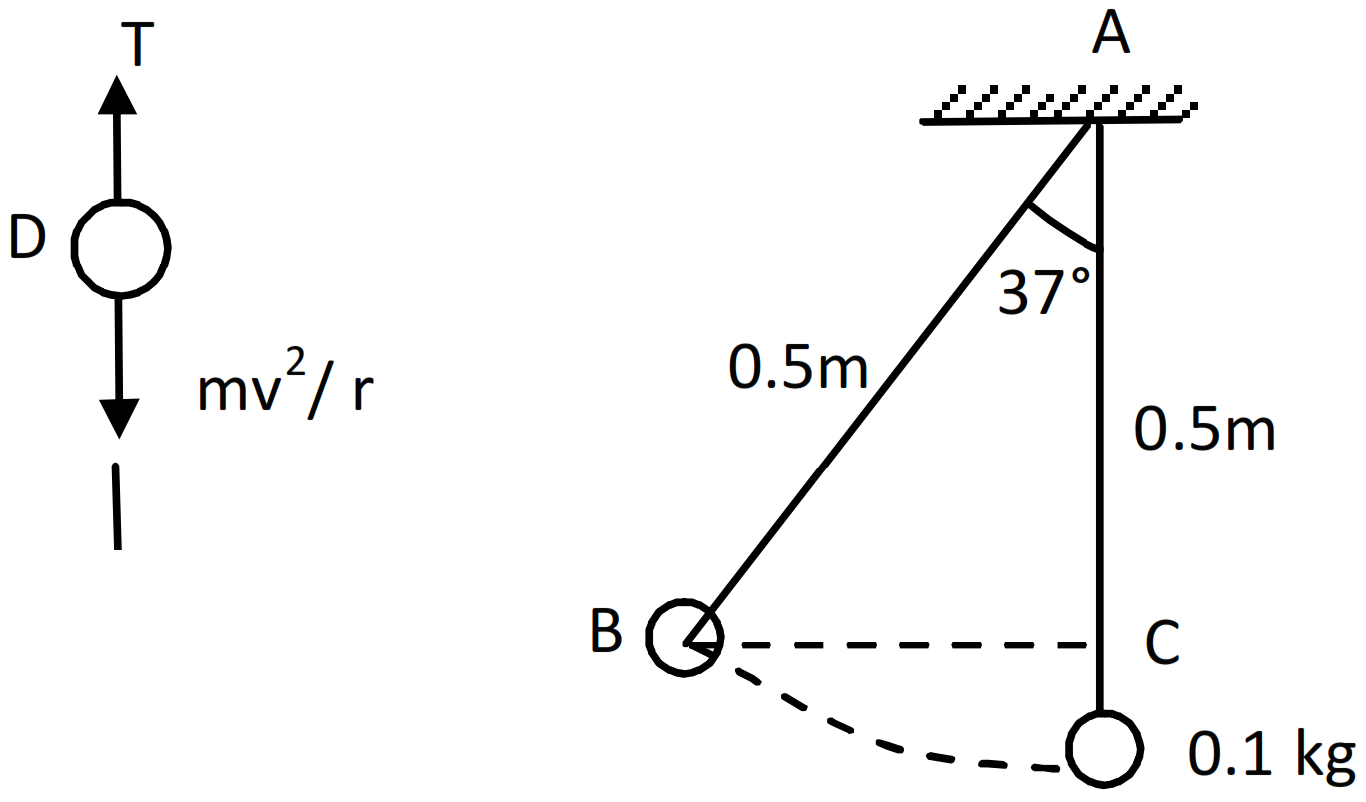
A simple pendulum consists of a 50cm long string connected to a 100g ball. The ball is pulled aside so that the string makes an angle of 37° with the vertical and is then released. Find the tension in the string when the bob is at its lowest position.
Answer

From the figure, $\cos\theta=\frac{\text{AC}}{\text{AB}}$

$\Rightarrow\text{AC}=\text{AB}\cos\theta$

$\Rightarrow(0.5)\times(0.8)=0.4$

So, CD = (0.5) - (0.4) = (0.1)m

Energy at D = energy at B

$\frac{1}{2}\text{mv}^2=\text{mg}(\text{CD})$

$\text{v}^2=2\times10\times(0.1)=2$

So, the tension is given by,

$\text{T}=\frac{\text{mv}^2}{\text{r}}+\text{mg}$

$\Rightarrow(0.1)\Big(\frac{2}{0.5}+10\Big)=1.4\text{N}$

Need a full question paper?

Generate a complete, print-ready paper with questions like this in minutes — across 16+ boards, with answer keys.

Start Generating Free

Similar questions

Using Bohr's total postulates, derive the expression for the total energy of the electron in the stationary states of hydrogen atom.
Let $\varepsilon_1$ and $\varepsilon_2$ be the angles made by $\overrightarrow{\text{A}}$ and $-\overrightarrow{\text{A}}$ with the positive X-axis. Show that $\tan\varepsilon_1=\tan\varepsilon_2.$ Thus, giving tane does not uniquely determine the direction of $\overrightarrow{\text{A}}.$
Comment on the following :(i) Electric conductivity.(ii) Dependence of resistivity and resistance on temperature.
Is Huygen’s principle valid for longitudunal sound waves?
The magnetic field in a plane electromagnetic wave is given by $\text{B}=(200\mu\text{T})\sin\Big[\big(4.0\times10^{15}\text{s}^{-1}\big)\Big(\text{t}-\frac{\text{x}}{\text{c}}\Big)\Big]$ Find the maximum electric field and the average energy density corresponding to the electric field.
An $\alpha$-particle collides with nucleus after passing through the potential V volt. Prove that distance of closest approach of particle of atomic number $Z$ to the nucleus will be $14.4( Z / V ) \ Å$.
(Given that : $1 / 4 \pi \varepsilon_0=9.0 \times 10^9$ Newton-meter $^2 /$ Coulomb $^2$ and $e=1.6 \times 10^{-19}$ Coulomb)
In $H _2$ atom, $r_0$ is radius of first Bohr's orbit. What will be the radius of second orbit? What will be the radius of single ionized helium atom?
Write two important considerations used while fabricating a Zener diode. Explain, with the help of a circuit diagram, the principle and working of a Zener diode as voltage regulator.
Calculate the energy released by 1g of natural uranium assuming 200MeV is released in each fission event and that the fissionable isotope 235U has an abundance of 0.7% by weight in natural uranium.
Two parallel wires carry equal currents of 10A along the same direction and are separated by a distance of 2.0cm. Find the magnetic field at a point which is 2.0cm away from each of these wires