MCQ
A simple pendulum doing small oscillations at a place $\mathrm{R}$ height above earth surface has time period of $T_1=4 \mathrm{~s}$. $T_2$ would be it's time period if it is brought to a point which is at a height $2 R$ from earth surface. Choose the correct relation $[R=$ radius of Earth]:
  • A
    $\mathrm{T}_1=\mathrm{T}_2$
  • B
    $2 \mathrm{~T}_1=3 \mathrm{~T}_2$
  •  $3 \mathrm{~T}_1=2 \mathrm{~T}_2$
  • D
    $2 \mathrm{~T}_1=\mathrm{T}_2$

Answer

Correct option: C.
 $3 \mathrm{~T}_1=2 \mathrm{~T}_2$
c
$\mathrm{T}_1=2 \pi \sqrt{\frac{\ell}{\mathrm{GM}}(2 \mathrm{R})^2}$

$\mathrm{~T}_2=2 \pi \sqrt{\frac{\ell}{\mathrm{GM}}(3 \mathrm{R})^2}$

$\therefore \frac{\mathrm{T}_1}{\mathrm{~T}_2}=\frac{2}{3}$

Need a full question paper?

Generate a complete, print-ready paper with questions like this in minutes — across 16+ boards, with answer keys.

Start Generating Free

Similar questions

A ball of mass $50 \,g$ is dropped from a height of $20 \,m$. A boy on the ground hits the ball vertically upwards with a bat with an average force of $200 \,N$, so that it attains a vertical height of $45 \,m$. The time for which the ball remains in contact with the bat is ........... of a second [Take $g=10 \,m / s ^2$ ]
The velocity of the bullet becomes one third after it penetrates $4\,cm$ in a wooden block. Assuming that bullet is facing a constant resistance during its motion in the block. The bullet stops completely after travelling at $(4+x)\,cm$ inside the block. The value of $x$ is$.....$
If two waves having amplitudes $2A$ and $A$ and same frequency and velocity, propagate in the same direction in the same phase, the resulting amplitude will be
The mean time period of second's pendulum is $2.00s$ and mean absolute error in the time period is $0.05s$. To express maximum estimate of error, the time period should be written as
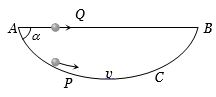
A particle $P$ is sliding down a frictionless hemispherical bowl. It passes the point $A$ at $t = 0$. At this instant of time, the horizontal component of its velocity is $v$. A bead $Q$ of the same mass as $P$ is ejected from $A$ at $t = 0$ along the horizontal string $AB$ (see figure) with the speed $v$. Friction between the bead and the string may be neglected. Let ${t_P}$ and ${t_Q}$ be the respective time taken by $P$ and $Q$ to reach the point $B$. Then
A source of sound is travelling with a velocity $40\, km/hour$ towards observer and emits sound of frequency $2000 Hz$. If velocity of sound is $1220 \,km/hour$, then what is the apparent frequency heard by an observer  .... $Hz$
A particle is placed at the origin and a force $F = kx$is acting on it (where $k$ is positive constant). If $U(0) = 0$, the graph of $U(x)$ versus x will be (where $U$ is the potential energy function)
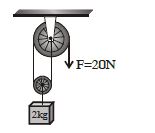
The acceleration of the $2\,kg$ block if the free end of string is pulled with a force of $20\,N$ as shown is
The total work done on a particle is equal to the change in its kinetic energy:
  1. Always.
  2. Only if the forces acting on it are conservative.
  3. Only if gravitational force alone acts on it.
  4. Only if elastic force alone acts on it.
A block of mass $100\, gm$ slides on a rough horizontal surface. If the speed of the block decreases from $10 \,m/s$ to $5\, m/s,$ the thermal energy developed in the process is............. $J$