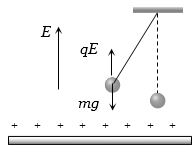
A simple pendulum has time period $T$. The bob is given negative charge and surface below it is given positive charge. The new time period will be
Easy
Download our app for free and get startedPlay store
(a) In this case time period of pendulum becomes
$T' = 2\pi \sqrt {\frac{l}{{\left( {g + \frac{{qE}}{m}} \right)}}} $
==> $T' < T$
art

Download our app
and get started for free

Experience the future of education. Simply download our apps or reach out to us for more information. Let's shape the future of learning together!No signup needed.*

Similar Questions

  • 1
    The frequency of oscillation of a mass $m$ suspended by a spring is $v_1$. If length of spring is cut to one third then the same mass oscillates with frequency $v_2$, then
    View Solution
  • 2
    The variation of kinetic energy $(KE)$ of a particle executing simple harmonic motion with the displacement $(x)$ starting from mean position to extreme position $(A)$ is given by
    View Solution
  • 3
    A particle executes $SHM$ with amplitude of $20 \,cm$ and time period is $12\, sec$.  What is the minimum time required for it to move between two points $10\, cm$ on  either side of the mean position ..... $\sec$ ?
    View Solution
  • 4
    A particle of mass $m$ moves in a one-dimensional potential energy $U(x) = -ax^2 + bx^4,$ where $'a'$ and $'b'$ are positive constants. The angular frequency of small oscillations about the minima of the potential energy is equal to
    View Solution
  • 5
    A particle is moving with constant angular velocity along the circumference of a circle. Which of the following statements is true
    View Solution
  • 6
    A particle of mass $m$ in a unidirectional potential field have potential energy $U(x)=\alpha+2 \beta x^2$, where $\alpha$ and $\beta$ are positive constants. Find its time period of oscillation.
    View Solution
  • 7
    Two mutually perpendicular simple harmonic vibrations have same amplitude, frequency and phase. When they superimpose, the resultant form of vibration will be
    View Solution
  • 8
    For a simple pendulum, a graph is plotted between its kinetic energy $(KE)$ and potential energy $(PE)$ against its displacement $d.$ Which one of the following represents these correctly ? (graphs are schematic and not drawn to scale)
    View Solution
  • 9
    A potential is given by $V(x)=k(x+a)^2 / 2$ for $x < 0$ and $V(x)=k(x-a)^2 / 2$ for $x > 0$. The schematic variation of oscillation period $T$ for a particle performing periodic motion in this potential as a function of its energy $E$ is
    View Solution
  • 10
    A small block is connected to one end of a massless spring of un-stretched length $4.9 \ m$. The other end of the spring (see the figure) is fixed. The system lies on a horizontal frictionless surface. The block is stretched by $0.2$ $m$ and released from rest at $t =0$. It then executes simple harmonic motion with angular frequency $\omega=\frac{\pi}{3} \ rad / s$.

    Simultaneously at $t=0$, a small pebble is projected with speed $v$ from point $P$ at an angle of $45^{\circ}$ as shown in the figure. Point $P$ is at a horizontal distance of $10 \ cm$ from $O$. If the pebble hits the block at $t=1 \ s$, the value of $v$ is (take $g =10 \ m / s ^2$ )

    View Solution