Question
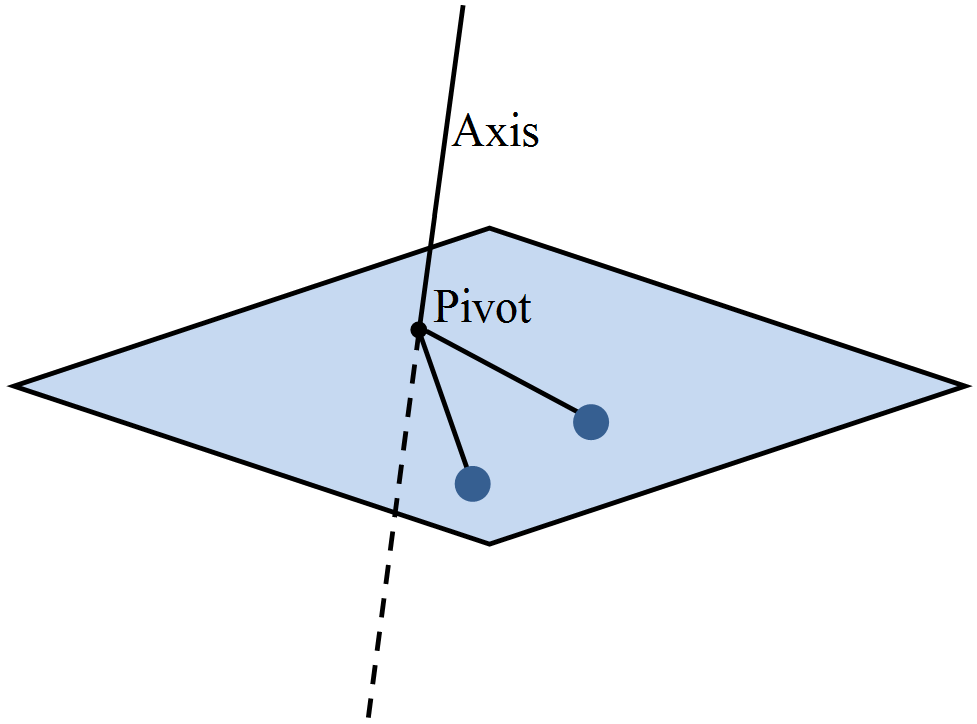
A simple pendulum is a point mass suspended by a light thread from a fixed point. The particle is displaced towards one side and then released. It makes small oscillations. Is the motion of such a simple pendulum a pure rotation? If yes, where is the axis of rotation?
Answer

Yes, it is an example of pure rotation.
The axis of rotation passes through the pivot of the pendulum, perpendicular to the plane containing the pendulum.

Need a full question paper?

Generate a complete, print-ready paper with questions like this in minutes — across 16+ boards, with answer keys.

Start Generating Free

Similar questions

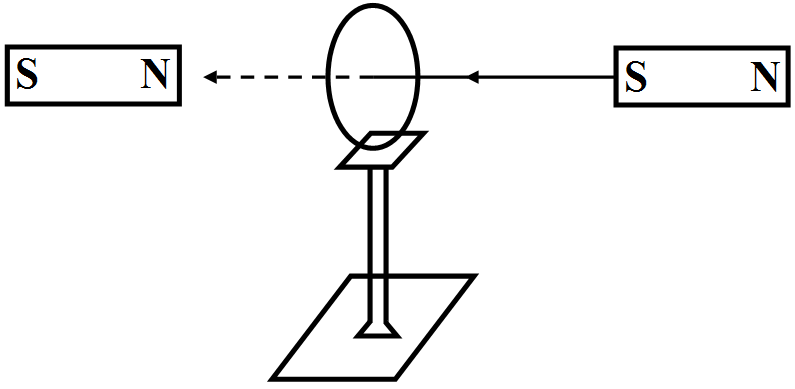
Give the direction in which the induced current flows in the coil mounted on an insulating stand when a bar magnet is quickly moved along the axis of the coil from one side to the other as shown in the figure alongside.
A magician during a show makes a glass lens with $n=1.47$ disappear in a trough of liquid. What is the refractive index of the liquid? Could the liquid be water?
If the angle between the pass axis of polarizer and the analyser is 45°, write the ratio of the intensities of original light and the transmitted light after passing through the analyser.
On what components does diffraction depend?
Is energy produced when a transformer steps up the voltage?
Do two distinct poles actually exist at two nearby points in a magnetic dipole?
What is the necessary condition for diffraction of light?
Plot a graph showing variation of current versus voltage for the material GaAs.
The potential on any two parallel surfaces is equal. The distance between them is r. If a charge is moved from one surface to another, what will be the work done in this situation?
A metal block of density $6000 \mathrm{~kg} \mathrm{~m}^{-3}$ and mass 1.2 kg is suspended through a spring of spring constant $200 \mathrm{~N} \mathrm{~m}^{-1}$. The spring-block system is dipped in water kept in a vessel. The water has a mass of 260 g and the block is at a height 40 cm above the bottom of the vessel. If the support to the spring is broken, what will be the rise in the temperature of the water. Specific heat capacity of the block is $250 \mathrm{Jkg}^{-1} \mathrm{~K}^{-1}$ and that of water is $4200 \mathrm{Jkg}^{-1} \mathrm{~K}^{-1}$. Heat capacities of the vessel and the spring are negligible.