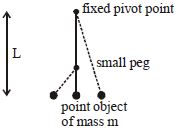
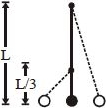
A simple pendulum of length $L$ is constructed from a point object of mass $m$ suspended by a massless string attached to a fixed pivot point. $A$ small peg is placed a distance $2L/3$ directly below the fixed pivot point so that the pendulum would swing as shown in the figure below. The mass is displaced $5$ degrees from the vertical and released. How long does it take to return to its starting position?
Diffcult
Download our app for free and get started
Time period $\propto \sqrt{L}$

Download our appand get started for free
Experience the future of education. Simply download our apps or reach out to us for more information. Let's shape the future of learning together!No signup needed.*
Similar Questions
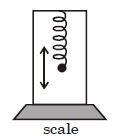
- 1View SolutionA mass hangs from a spring and oscillates vertically. The top end of the spring is attached to the top of a box, and the box is placed on a scale, as shown in the figure. The reading on the scale is largest when the mass is
- 2View SolutionWhen a particle executes simple Harmonic motion, the nature of graph of velocity as function of displacement will be.
- 3View SolutionThe equation of simple harmonic motion may not be expressed as (each term has its usual meaning)
- 4A vibratory motion is represented by $x = 2\,A\,\cos \,\omega t + A\,\cos \,\left( {\omega t + \frac{\pi }{2}} \right) + A\,\cos \,\left( {\omega t + \pi } \right) + \frac{A}{2}\,\cos \,\left( {\omega t + \frac{{3\pi }}{2}} \right)$ The resultant amplitude of motion isView Solution
- 5Two simple pendulums of length $1\, m$ and $4\, m$ respectively are both given small displacement in the same direction at the same instant. They will be again in phase after the shorter pendulum has completed number of oscillations equal toView Solution
- 6For a particle showing motion under the force $F=-5(x-2)^2$, the motion is .......View Solution
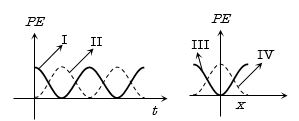
- 7For a particle executing $S.H.M.$ the displacement $x$ is given by $x = A\cos \omega t$. Identify the graph which represents the variation of potential energy $(P.E.)$ as a function of time $t$ and displacement $x$View Solution
- 8A flat horizontal board moves up and down under $S.H.M.$ vertically with amplitude $A$. The shortest permissible time period of the vibration such that an object placed on the board may not lose contact with the board is ..........View Solution
- 9A pendulum is hung from the roof of a sufficiently high building and is moving freely to and fro like a simple harmonic oscillator. The acceleration of the bob of the pendulum is $20\; m/s^2$ at a distance of $5\; m$ from the mean position. The time period of oscillation isView Solution
- 10A particle executes linear simple harmonic motion with an ampilitude of $3\,cm$ . When the particle is at $2\,cm$ from the mean position , the magnitude of its velocity is equal to that of its acceleration. Then its time period in seconds isView Solution