A simple pendulum oscillates in air with time period $T$ and amplitude $A$. As the time passes
Easy


Download our appand get started for free
Experience the future of education. Simply download our apps or reach out to us for more information. Let's shape the future of learning together!No signup needed.*
Similar Questions
- 1A particle is performing $S.H.M.$ with energy of vibration $90 \,J$ and amplitude $6 \,cm$. When the particle reaches at distance $4 \,cm$ from mean position, it is stopped for a moment and then released. The new energy of vibration will be ........... $J$View Solution
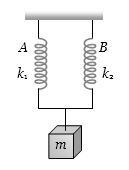
- 2A mass $m$ is suspended by means of two coiled spring which have the same length in unstretched condition as in figure. Their force constant are $k_1$ and $k_2$ respectively. When set into vertical vibrations, the period will beView Solution
- 3A simple pendulum is placed at a place where its distance from the earth's surface is equal to the radius of the earth. If the length of the string is $4 \mathrm{~m}$, then the time period of small oscillations will be ____ $s$. $\left[\right.$ take $\left.\mathrm{g}=\pi^2 \mathrm{~ms}^{-2}\right]$View Solution
- 4The position co-ordinates of a particle moving in a $3-D$ coordinates system is given by $x = a\,cos\,\omega t$ , $y = a\,sin\,\omega t$ and $z = a\omega t$ The speed of the particle isView Solution
- 5The motion of a simple pendulum excuting $S.H.M$. is represented by following equation.View Solution
$Y = A \sin (\pi t +\phi)$, where time is measured in $second$.
The length of pendulum is .............$cm$
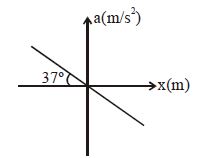
- 6The acceleration displacement graph of a particle executing $SHM$ is shown in figure. The time period of simple harmonic motion isView Solution
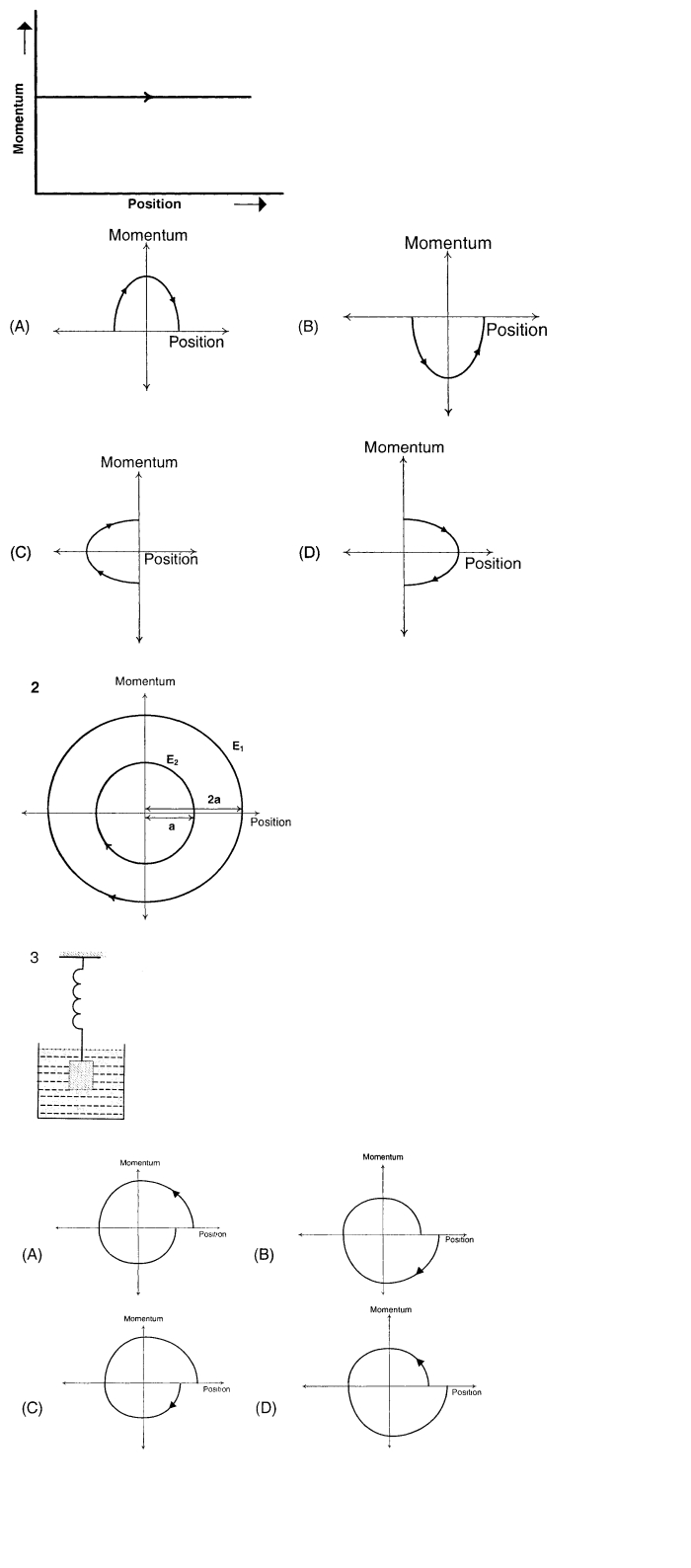
- 7Phase space diagrams are useful tools in analyzing all kinds of dynamical problems. They are especially useful in studying the changes in motion as initial position and momentum are changed. Here we consider some simple dynamical systems in one-dimension. For such systems, phase space is a plane in which position is plotted along horizontal axis and momentum is plotted along vertical axis. The phase space diagram is $x(t)$ vs. $p(t)$ curve in this plane. The arrow on the curve indicates the time flow. For example, the phase space diagram for a particle moving with constant velocity is a straight line as shown in the figure. We use the sign convention in which position or momentum upwards (or to right) is positive and downwards (or to left) is negative. $Image$View Solution
$1.$ The phase space diagram for a ball thrown vertically up from ground is
mcq $Image$
$2.$ The phase space diagram for simple harmonic motion is a circle centered at the origin. In the figure, the two circles represent the same oscillator but for different initial conditions, and $E_1$ and $E_2$ are the total mechanical energies respectively. Then $Image$
$(A)$ $ E_1=\sqrt{2} E_2$ $(B)$ $ E_1=2 E_2$
$(C)$ $ E_1=4 E_2$ $(D)$ $ E_1=16 E_2$
$3.$ Consider the spring-mass system, with the mass submerged in water, as shown in the figure. The phase space diagram for one cycle of this system is $Image$
mcq $Image$
Give the answer question $1,2$ and $3.$
- 8A body is moving in a room with a velocity of $20\, m / s$ perpendicular to the two walls separated by $5$ meters. There is no friction and the collisions with the walls are elastic. The motion of the body isView Solution
- 9A point performs simple harmonic oscillation of period $T$ and the equation of motion is given by $x=Asin$$\left( {\omega t + \frac{\pi }{6}} \right)$. After the elapse of what fraction of the time period the velocity of the point will be equal to half of its maximum velocity?View Solution
- 10Three simple harmonic motions of equal amplitudes $A$ and equal time periods in the same direction combine. The phase of the second motion is $60^o$ ahead of the first and the phase of the third motion is $60^o$ ahead of the second. Find the amplitude of the resultant motionView Solution