-
$\frac{\lambda}{4}$
-
$\frac{\lambda}{3}$
-
$\frac{\lambda}{2}$
-
$\lambda.$
$\frac{\lambda}{4}$
$\frac{\lambda}{3}$
$\frac{\lambda}{2}$
$\lambda.$
$\frac{\lambda}{2}$
Explanation:
A sine wave has a maxima and a minima and the particle displacement has phase difference of $\pi$ radians. Therefore, applying similar argument we can say that if a particular particle has zero displacement at a certain instant. then the particle closest to it having zero displacement is at a distance is equal to $\frac{\lambda}{2}.$
Generate a complete, print-ready paper with questions like this in minutes — across 16+ boards, with answer keys.
Three observers A, B and C measure the speed of light coming from a source to be
and
. The observer A moves towards the source, the observer C moves away from the source with the same speed. The observer B stays stationary. the surrounding space is vacuum every where. Then
|
(a) |
(b) |
(c) |
(d) |
An electric bulb illuminates a plane surface. The intensity of illumination on the surface at a point 2m away from the bulb is 5
phot (lumen/cm2). The line joining the bulb to the point makes an angle of 60o with the normal to the surface. The intensity of the bulb in candela is
|
(a) 40 |
(b) 40 |
(c) 20 |
(d) 40 |
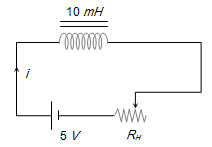
The resistance in the following circuit is increased at a particular instant. At this instant the value of resistance is 10W. The current in the circuit will be now

|
(a) i = 0.5 A |
(b) i > 0.5 A |
(c) i < 0.5 A |
(d) i = 0 |
The magnetic potential at a point on the axial line of a bar magnet of dipole moment M is V. What is the magnetic potential due to a bar magnet of dipole moment
at the same point
| (a) 4V | (b) 2V |
(c) |
(d) |
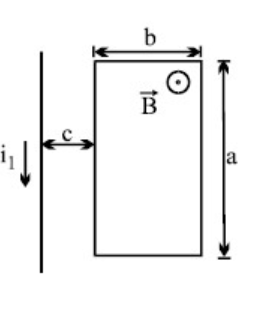
What is the net force on the square coil
|
(a) 25 |
(b) 25 |
|
(c) 35 |
(d) 35 |