MCQ
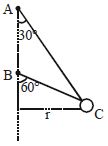
A single wire $ACB$ passes through a smooth ring at $C$ which revolves at a constant speed in the horizontal circle of radius $r$ as shown in the figure. The speed of revolution is
  • $\sqrt{rg}$
  • B
    $\sqrt{2rg}$
  • C
    $2\sqrt{2rg}$
  • D
    $2\sqrt{rg}$

Answer

Correct option: A.
$\sqrt{rg}$
a
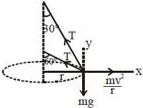
Force equation from ring frame along $y-axis$

$\mathrm{T} \cos 30^{\circ}+\mathrm{T} \cos 60^{\circ}=\mathrm{mg}$

$\mathrm{T} \times\left(\frac{\sqrt{3}+1}{2}\right)=\mathrm{mg}$          $...(i)$

along $x-axis$

$\mathrm{T} \sin 30^{\circ}+\mathrm{T} \sin 60^{\circ}=\frac{\mathrm{mv}^{2}}{\mathrm{r}}$

$\mathrm{T}\left(\frac{\sqrt{3}+1}{2}\right)=\frac{\mathrm{mv}^{2}}{\mathrm{r}}$        $...(ii)$

$(ii)$ $/( i)$ we get

$\mathrm{v}=\sqrt{\mathrm{rg}}$
Need a full question paper?

Generate a complete, print-ready paper with questions like this in minutes — across 16+ boards, with answer keys.
Start Generating Free

Similar questions

Find the maximum velocity for skidding for a car moved on a circular track of radius $100\, m$. The coefficient of friction between the road and tyre is $0.2$ ....... $m/s$
In an experiment, mass of an object is measured by applying a known force on it, and then measuring its acceleration. If in the experiment, the measured values of applied force and the measured acceleration are $F=10.0 \pm 0.2 \,N$ and $a=1.00 \pm 0.01 \,m / s ^2$, respectively. Then, the mass of the object is ............... $kg$
An ideal heat engine exhausting heat at $77\,^oC$. To have a $30\%$ efficiency. It must take heat at...... $^oC$
A gas obeying the equation of state $p V=R T$ undergoes a hypothetical reversible process described by the equation, $p V^{5 / 3} \exp \left(-\frac{p V}{E_{0}}\right)=C_{1}$, where $C_{1}$ and $E_{0}$ are dimensioned constants. Then, for this process, the thermal compressibility at high temperature
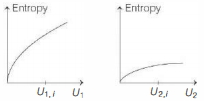
Graphs below show the entropy versus energy $U$ of two systems $1$ and $2$ at constant volume. The initial energies of the systems are indicated by $U_{1, i}$ and $U_{2, i}$, respectively. Graphs are drawn to the same scale. The systems are then brought into thermal contact with each other. Assume that, at all times the combined energy of the two systems remains constant. Choose the most appropriate option indicating the energies of the two systems and the total entropy after they achieve the equilibrium.
The temperature of $3.00\, {mol}$ of an ideal diatomic gas is increased by $40.0^{\circ} {C}$ without changing the pressure of the gas. The molecules in the gas rotate but do not oscillate. If the ratio of change in internal energy of the gas to the amount of workdone by the gas is $\frac{{x}}{10} .$ Then the value of ${x}$ (round off to the nearest integer) is ..... . $\left(\right.$ Given $\left.{R}=8.31\, {J} {mol}^{-1} {K}^{-1}\right)$
Four pieces of iron heated in a furnace to different temperatures show different colours listed below. Which one has the highest temperature
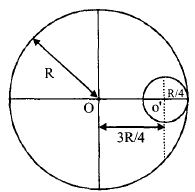
A circular hole of radius $\frac{R}{4}$ is made in a thin uniform disc having mass $M$ and radius $R$, as shown in figure. The moment of inertia of the remaining portion of the disc about an axis passing through the point $O$ and perpendicular to the plane of the disc is
A stationary man observes that the rain is falling vertically downward. When he starts running with a velocity of  $12\,\,km/h$ he observes that the rains is falling at an angle $60^o$ with the vertical. The actual velocity of rain is
A body of mass $M$ at rest explodes into three pieces, in the ratio of masses $1: 1: 2$. Two smaller pieces fly off perpendicular to each other with velocities of $30 \,ms ^{-1}$ and $40 \,ms ^{-1}$ respectively. The velocity of the third piece will be ............... $\,ms ^{-1}$