MCQ
A Siren emitting sound of frequency $800 \;Hz$ is going away from a static listener with a speed of $30\; m/s$, frequency of the sound to be heard by the listener is... $Hz$ (take velocity of sound as $330 \;m/s$)
  • $733.3$
  • B
    $644.8$
  • C
    $481.2$
  • D
    $286.5$

Answer

Correct option: A.
$733.3$
a
(a) $n' = n\,\left( {\frac{v}{{v + {v_S}}}} \right) = 800\,\left( {\frac{{330}}{{330 + 30}}} \right)\, = 733.33\,Hz$.

Need a full question paper?

Generate a complete, print-ready paper with questions like this in minutes — across 16+ boards, with answer keys.

Start Generating Free

Similar questions

An iron block is dropped into a deep well. Sound of splash is heard after $4.23 \,s$. If the depth of the well is $78.4 \,m$, then find the speed of sound in air is ............ $m / s$ $\left(g=9.8 \,m / s ^2\right)$
Two exactly similar wires of steel and copper are stretched by equal forces. If the difference in their elongations is $0.5$ cm, the elongation $(l)$ of each wire is ${Y_s}({\rm{steel}}) = 2.0 \times {10^{11}}\,N/{m^2}$${Y_c}({\rm{copper}}) = 1.2 \times {10^{11}}\,N/{m^2}$
In a liquid flowing through a pipe, the pressure difference between its ends is made half and the radius is doubled. If the initial rate of flow of liquid was $Q$. What is the new rate of flow of liquid through the pipe?
In an experiment for determination of the focal length of a thin convex lens, the distance of the object from the lens is $10 \pm 0.1 \mathrm{~cm}$ and the distance of its real image from the lens is $20 \pm 0.2 \mathrm{~cm}$. The error in the determination of focal length of the lens is $n \%$. The value of $n$ is. . . . . . .
A hollow spherical shell at outer radius $R$ floats just submerged under the water surface. The inner radius of the shell is $r$. If the specific gravity of the shell material is $\frac{27}{8}$ $w.r.t.$ water, the value of $r$ is$......R$
The isothermal elasticity of a gas is equal to
During an experiment, an ideal gas is found to obey a condition $VP^2 =$ constant. The gas is initially at a temperature $T$, pressure $P$ and volume $V.$ The gas expands to volume $4V$. 
The components of $\vec a = 2\hat i + 3\hat j$ along the direction of vector $\left( {\hat i + \hat j} \right)$ is
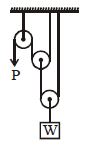
The ideal mechanical advantage of the combination of pulleys shown is
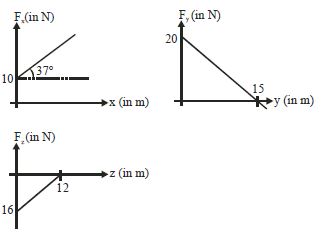
The components of a force acting on a particle are varying according to the graphs shown. To reach at point $B\, (8, 20, 0)$ from point $A\,(0, 5, 12)$ the particle moves on paths parallel to $x-$ axis then $y-$ axis and then $z-$ axis, then work done by this force is ............ $\mathrm{J}$