MCQ
A slab consists of two parallel layers of copper and brass of the same thickness and having thermal conductivities in the ratio $1 : 4$ . If the free face of brass is at ${100^o}C$ and that of copper at $0^\circ C $, the temperature of interface is ........ $^oC$
  • $80$
  • B
    $20$
  • C
    $60$
  • D
    $40$

Answer

Correct option: A.
$80$
a
(a) Temperature of interface $\theta = \frac{{{K_1}{\theta _1} + {K_2}{\theta _2}}}{{{K_1} + {K_2}}}$

$(\because \,\frac{{{K_1}}}{{{K_2}}} = \frac{1}{4} \Rightarrow  \,\,If\,\, K_1 = K \,\,then \,\,K_2 = 4K)$

==> $\theta = \frac{{K \times 0 + 4K \times 100}}{{5\,K}}$= $80°C$

Need a full question paper?

Generate a complete, print-ready paper with questions like this in minutes — across 16+ boards, with answer keys.

Start Generating Free

Similar questions

An object may have:
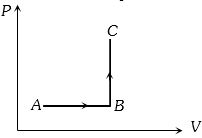
The $P-V$ diagram of a system undergoing thermodynamic transformation is shown in figure. The work done by the system in going from $A \to B \to C$ is $30J$ and $40J$ heat is given to the system. The change in internal energy between $A$ and $C$ is ....... $J$
When a massive body suffers an elastic collision with a stationary light body, then massive body approximately comes to rest and light body-
An isolated rail car of mass $M$ is moving along a straight, frictionless track at an initial speed $v_0$. The car is passing under a bridge when $a$ crate filled with $N$ bowling balls, each of mass $m$, is dropped from the bridge into the bed of the rail car. The crate splits open and the bowling balls bounce around inside the rail car, but none of them fall out. What is the average speed of the rail car $+$ bowling balls system some time after the collision?
A body of mass $1000 \mathrm{~kg}$ is moving horizontally with a velocity $6 \mathrm{~m} / \mathrm{s}$. If $200 \mathrm{~kg}$ extra mass is added, the final velocity (in $\mathrm{m} / \mathrm{s}$ ) is:
For an adiabatic expansion of an ideal gas, the fractional change in its pressure is equal to (where $\gamma$ is the ratio of specific heats):
A moving block having mass $m,$ collides with another stationary block having mass $4\,m$ . The lighter block comes to rest after collision. When the initial velocity of the lighter block is $v,$ then the value of coefficient of restitution $( e)$ will be
A particle is situated at the origin of a coordinate system. The following forces begin to act on the particle simultaneously (Assuming particle is initially at rest)

${\vec F_1} = 5\hat i - 5\hat j + 5\hat k$            ${\vec F_2} = 2\hat i + 8\hat j + 6\hat k$

${\vec F_3} =  - 6\hat i + 4\hat j - 7\hat k$         ${\vec F_4} =  - \hat i - 3\hat j - 2\hat k$

Then the particle will move

A $120 \,m$ long train is moving towards west with a speed of $10\, m/s$. A bird flying towards east with a speed of $5\, m/s$ crosses the train. The time taken by the bird to cross the train will be........$sec$
Consider a $1\, c.c.$ sample of air at absolute temperature ${T_0}$ at sea level and another $1 cc$ sample of air at a height where the pressure is one-third atmosphere. The absolute temperature $T$ of the sample at that height is