MCQ
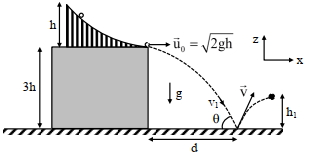
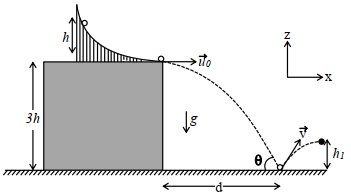
A slide with a frictionless curved surface, which becomes horizontal at its lower end,, is fixed on the terrace of a building of height $3 h$ from the ground, as shown in the figure. A spherical ball of mass $\mathrm{m}$ is released on the slide from rest at a height $h$ from the top of the terrace. The ball leaves the slide with a velocity $\vec{u}_0=u_0 \hat{x}$ and falls on the ground at a distance $d$ from the building making an angle $\theta$ with the horizontal. It bounces off with a velocity $\overrightarrow{\mathrm{v}}$ and reaches a maximum height $h_l$. The acceleration due to gravity is $g$ and the coefficient of restitution of the ground is $1 / \sqrt{3}$. Which of the following statement($s$) is(are) correct?

($AV$) $\vec{u}_0=\sqrt{2 g h} \hat{x}$ ($B$) $\vec{v}=\sqrt{2 g h}(\hat{x}-\hat{z})$  ($C$) $\theta=60^{\circ}$  ($D$) $d / h_1=2 \sqrt{3}$
  • $A,C,D$
  • B
    $A,C,B$
  • C
    $A,C$
  • D
    $A,D$

Answer

Correct option: A.
$A,C,D$
a
$\overrightarrow{\mathrm{v}}_1=\sqrt{2 g h} \hat{\mathrm{i}}-\sqrt{2 g 3 \mathrm{~h}} \hat{\mathrm{k}}$

$\overrightarrow{\mathrm{v}}=\sqrt{2 g h} \hat{\mathrm{i}}+\sqrt{2 g 3 \mathrm{~h}} \times \frac{1}{\sqrt{3}} \hat{\mathrm{k}}$

$=\sqrt{2 g h} \hat{\mathrm{i}}+\sqrt{2 g h} \hat{\mathrm{k}}$

$\tan \theta=\frac{\sqrt{2 g 3 \mathrm{~h}}}{\sqrt{2 g h}}=\sqrt{3} \quad \theta=60^{\circ}$

$\mathrm{h}_1=\frac{\mathrm{v}_{1 y}^2}{2 \mathrm{~g}}=\frac{2 g h}{2 \mathrm{~g}}=\mathrm{h}$

$\mathrm{d}=\mathrm{v}_x \mathrm{t}=\sqrt{2 g h} \times \sqrt{\frac{2 \times 3 \mathrm{~h}}{\mathrm{~g}}}$

$=\sqrt{2 g h} \sqrt{\frac{6 \mathrm{~h}}{\mathrm{~g}}}=2 \sqrt{3 \mathrm{~h}}$

$=\frac{\mathrm{d}}{\mathrm{h}_1}=2 \sqrt{3}$

Need a full question paper?

Generate a complete, print-ready paper with questions like this in minutes — across 16+ boards, with answer keys.

Start Generating Free

Similar questions

For angles of projection of a projectile at angle $(45^o  +\theta)$ and $(45^o  -\theta ) $ , the horizontal range described by the projectile are in the ratio of 
A particle reaches its highest point when it has covered exactly one half of its horizontal range. The corresponding point on the displacement time graph is characterised by
The property utilized in the manufacture of lead shots is
A tuning fork of known frequency $256\,Hz$ makes $5$ beats per second with the vibrating string of a piano. The beat frequency decreases to $2$ beats per second when the tension in the piano string is slightly increased. The frequency of the piano string before increasing the tension was
If in a stationary wave the amplitude corresponding to antinode is $4 \,cm$, then the amplitude corresponding to a particle of medium located exactly midway between a node and an antinode is ........... $cm$
A rigid body rotates about a fixed axis with variable angular velocity equal to $\alpha -\beta t$, where $t$ is time and $\alpha \,,\, \beta $ are constants. The angle (in radian) through which it rotates before its stops
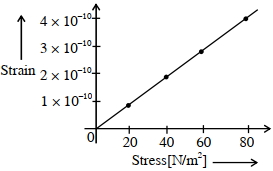
The elastic behaviour of material for linear streass and linear strain, is shown in the figure. The energy density for a linear strain of $5 \times 10^{-4}$ is $\dots \; kJ / m ^{3}$. Assume that material is elastic upto the linear strain of $5 \times 10^{-4}$.
A given object takes $n$ times the time to slide down $45^{\circ}$ rough inclined plane as it takes the time to slide down an identical perfectly smooth $45^{\circ}$ inclined plane. The coefficient of kinetic friction between the object and the surface of inclined plane is :
The length and width of a rectangular room are measured to be $3.95 \pm 0.05 \,m$ and $3.05 \pm 0.05 \,m$, respectively. The area of the floor is .................... $m^2$
A cubical block of side $0.5\,m$ floats on water with $30\%$ of its volume under water. ....... $kg$ is the maximum weight that can be put on the block without fully submerging it under water ? [Take density of water $= 10^3\,kg/m^3$ ]