MCQ
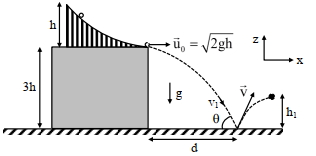
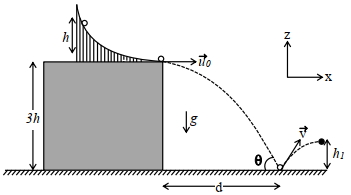
A slide with a frictionless curved surface, which becomes horizontal at its lower end,, is fixed on the terrace of a building of height $3 h$ from the ground, as shown in the figure. A spherical ball of mass $\mathrm{m}$ is released on the slide from rest at a height $h$ from the top of the terrace. The ball leaves the slide with a velocity $\vec{u}_0=u_0 \hat{x}$ and falls on the ground at a distance $d$ from the building making an angle $\theta$ with the horizontal. It bounces off with a velocity $\overrightarrow{\mathrm{v}}$ and reaches a maximum height $h_l$. The acceleration due to gravity is $g$ and the coefficient of restitution of the ground is $1 / \sqrt{3}$. Which of the following statement($s$) is(are) correct?

($AV$) $\vec{u}_0=\sqrt{2 g h} \hat{x}$ ($B$) $\vec{v}=\sqrt{2 g h}(\hat{x}-\hat{z})$  ($C$) $\theta=60^{\circ}$  ($D$) $d / h_1=2 \sqrt{3}$
  • $A,C,D$
  • B
    $A,C,B$
  • C
    $A,C$
  • D
    $A,D$

Answer

Correct option: A.
$A,C,D$
a
$\overrightarrow{\mathrm{v}}_1=\sqrt{2 g h} \hat{\mathrm{i}}-\sqrt{2 g 3 \mathrm{~h}} \hat{\mathrm{k}}$

$\overrightarrow{\mathrm{v}}=\sqrt{2 g h} \hat{\mathrm{i}}+\sqrt{2 g 3 \mathrm{~h}} \times \frac{1}{\sqrt{3}} \hat{\mathrm{k}}$

$=\sqrt{2 g h} \hat{\mathrm{i}}+\sqrt{2 g h} \hat{\mathrm{k}}$

$\tan \theta=\frac{\sqrt{2 g 3 \mathrm{~h}}}{\sqrt{2 g h}}=\sqrt{3} \quad \theta=60^{\circ}$

$\mathrm{h}_1=\frac{\mathrm{v}_{1 y}^2}{2 \mathrm{~g}}=\frac{2 g h}{2 \mathrm{~g}}=\mathrm{h}$

$\mathrm{d}=\mathrm{v}_x \mathrm{t}=\sqrt{2 g h} \times \sqrt{\frac{2 \times 3 \mathrm{~h}}{\mathrm{~g}}}$

$=\sqrt{2 g h} \sqrt{\frac{6 \mathrm{~h}}{\mathrm{~g}}}=2 \sqrt{3 \mathrm{~h}}$

$=\frac{\mathrm{d}}{\mathrm{h}_1}=2 \sqrt{3}$

Need a full question paper?

Generate a complete, print-ready paper with questions like this in minutes — across 16+ boards, with answer keys.

Start Generating Free

Similar questions

The point on the pressure temperature phase diagram where all the phases co-exist is called
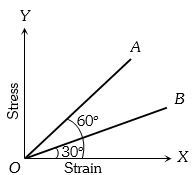
The stress versus strain graphs for wires of two materials $A$ and $B$ are as shown in the figure. If ${Y_A}$ and ${Y_B}$ are the Young ‘s modulii of the materials, then
Dimensional Formula of Universal Gas Constant is
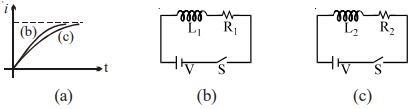
Current growth in two $L-R$ circuits $(b)$ and $(c)$ as shown in figure $(a)$. Let $L_1, L_2, R_1$ and $R_2$ be the corresponding values in two circuits. Then
The radius of curvature of the path of the charged particle in a uniform magnetic field is directly proportional to
A coil of inductance $1\,H$ and resistance $100\,\Omega$ is connected to a battery of $6\,V$. Determine approximately :

$(a)$ The time elapsed before the current acquires half of its steady - state value

$(b)$ The energy stored in the magnetic field associated with the coil at an instant $15\,ms$ after the circuit is switched on. (Given In $2=0.693$, $\left.e ^{-3 / 2}=0.25\right)$

If the linear momentum is increased by $50\%$, the kinetic energy will increase by ............. $\%$
The radiant energy from the sun incident normally at the surface of earth is $20\, \frac{{k\;cal}}{{{m^2}\;min}}$. What would have been the radiant energy incident normally on the earth, if the sun had a temperature twice of the present one ....... $kcal/m ^2 \,min$
A cord is wound round the circumference of wheel of radius $r$. The axis of the wheel is horizontal and the moment of inertia about it is $I. \,A$ weight $mg$ is attached to the cord at the end. The weight falls from rest. After falling through a distance $ 'h '$, the square of angular velocity of wheel will be ..... .
For proper ventilation of building, windows must be open near the bottom and top of the walls so as to let pass