Question
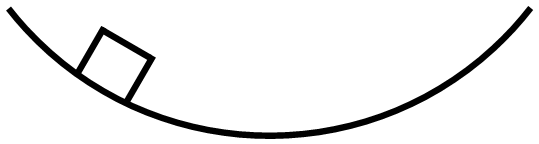
A small block oscillates back and forth on a smooth concave surface of radius R figure. Find the time period of small oscillation.
Answer

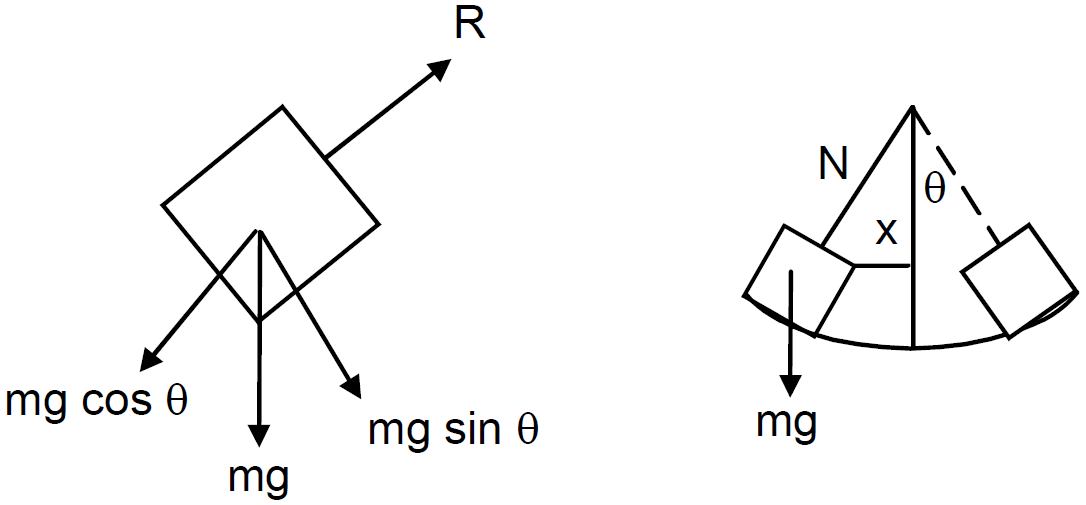
Given that, R = radius. Let N = normal reaction. Driving force $\text{F}=\text{mg}\sin\theta.$ Acceleration $=\text{a}=\text{g}\sin\theta$ As, $\sin\theta$ is very small, $\sin\theta\rightarrow\theta$$\therefore$ Acceleration $\text{a}=\text{g}\theta$
Let ‘x’ be the displacement from the mean position of the body,$\therefore\theta=\frac{\text{x}}{\text{R}}$
$\Rightarrow\text{a}=\text{g}\theta=\text{g}\Big(\frac{\text{x}}{\text{R}}\Big)\Rightarrow\Big(\frac{\text{a}}{\text{x}}\Big)=\Big(\frac{\text{g}}{\text{R}}\Big)$
So the body makes S.H.M.$\therefore\text{T}=2\pi\sqrt{\frac{\text{Displacement}}{\text{Acceleration}}}=2\pi\sqrt{\frac{\text{x}}{\frac{\text{gx}}{\text{R}}}}=2\pi\sqrt{\frac{\text{R}}{\text{g}}}$

Need a full question paper?

Generate a complete, print-ready paper with questions like this in minutes — across 16+ boards, with answer keys.
Start Generating Free

Similar questions

Two long, straight wires, each carrying a current of 5A, are placed along the X and Y-axes respectively. The currents point along the positive directions of the axes. Find the magnetic fields at the points $(a) (1m, 1m), (b) (-1m, 1m), (c) (-1m,-1m)$ and $(d) (1m, -1m),$
4.0g of helium occupies $22400cm^3$ at STP. The specific heat capacity of helium at constant pressure is $5.0cal-K^{-1}mol^{-1}.$ Calculate the speed of sound in helium at STP.
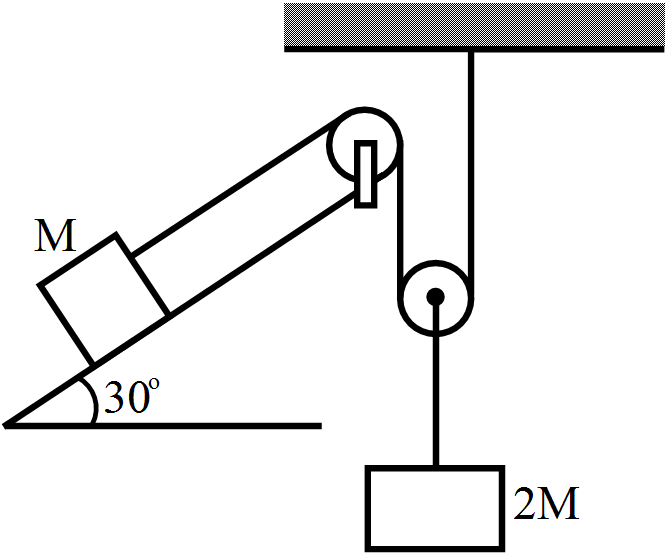
Find the acceleration of the block of mass M in the situation shown in figure. All the surfaces are frictionless and the pulleys and the string are light.
The half-life of $^{199}Au$ is 2.7 days.
  1. Find the activity of a sample containing $1.00\mu\text{g}$ of $^{198}Au.$
  2. What will be the activity after 7 days? Take the atomic weight of $^{198}Au$ to be 198g/mol.
Explain the vector form of Coulomb's law and write its important facts.
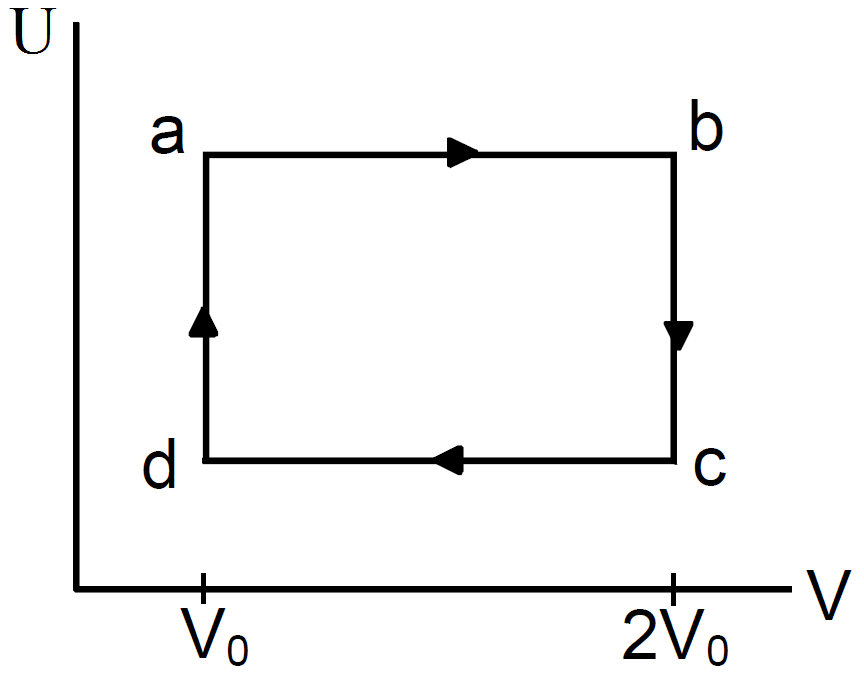
Figure. shows the variation in the internal energy U with the volume V of 2.0mol of an ideal gas in a cyclic process abcda. The temperatures of the gas at b and c are 500K and 300K respectively. Calculate the heat absorbed by the gas during the process.
A small source of sound S of frequency 500Hz is attached to the end of a light string and is whirled in a vertical circle of radius 1.6m. The string just remains tight wher the source is at the highest point.
  1. An observer is located in the same vertical plane at a large distance and at the same height as the centre of the circle figure. The speed of sound in air = 330m/s and g = 10m/s 2. Find the maximum frequency heard by the observer.
  2. An observer is situated at a large distance vertically above the centre of the circle. Find the frequencies heard by the observer corresponding to the sound emitted by the source when it is at the same height as the centre.
A parallel-plate capacitor with the plate area $100cm^2$ and the separation between the plates 1.0cm is connected across a battery of emf 24 volts. Find the force of attraction between the plates.
A block of mass m is kept over another block of mass M and the system rests on a horizontal surface figure. A constant horizontal force F acting on the lower block produces an acceleration $\frac{\text{F}}{2(\text{m+M})}$ in the system, the two blocks always move together.
  1. Find the coefficient of kinetic friction between the bigger block and the horizontal surface.
  2. Find the frictional force acting on the smaller block.
  3. Find the work done by the force of friction on the smaller block by the bigger block during a displacement d of the system.
Derive Snell's law for refraction of light by Huygen's wave theory.