Question
A small, conducting circular loop is placed inside a long solenoid carrying a current. The plane of the loop contains the axis of the solenoid. If the current in the solenoid is varied, the current induced in the loop is:
  1. Clockwise.
  2. Anticlockwise.
  3. Zero.
  4. Clockwise or anticlockwise depending on whether the resistance in increased or decreased.
Answer

  1. Zero.

Explanation:

The angle between magnetic field and area vector is 90°, so the flux associated with coil is zero. Although magnetic field is changing but flux is remaining constant equal to zero, so emf induced and hence current in the loop is equal to zero.

Need a full question paper?

Generate a complete, print-ready paper with questions like this in minutes — across 16+ boards, with answer keys.

Start Generating Free

Similar questions

A transverse wave propagating along X-axis is represented by
$\text{y (x, t)}=8.0\sin(0.5\pi\text{x}-4\pi\text{t}-\frac{\pi}{4})$
where x is in metre and t is in seconds. The speed of the wave is:
Let IA and IB be moments of inertia of a body about two axes A and B respectively. The axis A passes through the centre of mass of the body but B does not:
A projectile is thrown with an initial velocity of $(a \hat{ i }+b \hat{ j }) ms ^{-1}$. If the range of the projectile is twice the maximum height reached by it, then
Given below are two statements: one is labelled as Assertion $A$ and the other is labelled as Reason $R$

Assertion $A$: Steel is used in the construction of buildings and bridges.

Reason $R:$ Steel is more elastic and its elastic limit is high.

In the light of above statements, choose the most appropriate answer from the options given below

A vehicle travels half the distance with speed $v$ and the remaining distance with speed $2\,v$.Its average speed is :
An underwater sonar source operating at a frequency of $60 KHz$ directs its beam towards the surface. If the velocity of sound in air is $330\, m/s,$ the wavelength and frequency of waves in air are:
A solid copper sphere (density $\rho $ and specific heat capacity $c$ ) of radius $r$ at an initial temperature $200K$ is suspended inside a chamber whose walls are at almost $0K$ . The time required (in $\mu s$) for the temperature of the sphere to drop to $100\, K$  is
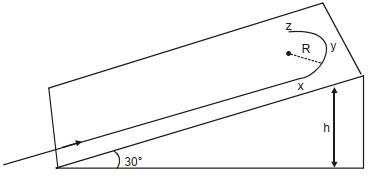
A student skates up a ramp that makes an angle $30^{\circ}$ with the horizontal. $He /$ she starts (as shown in the figure) at the bottom of the ramp with speed $v_0$ and wants to turn around over a semicircular path xyz of radius $R$ during which he/she reaches a maximum height $h$ (at point y) from the ground as shown in the figure. Assume that the energy loss is negligible and the force required for this turn at the highest point is provided by his/her weight only. Then ( $g$ is the acceleration due to gravity)

$(A)$ $v_0^2-2 g h=\frac{1}{2} g R$

$(B)$ $v_0^2-2 g h=\frac{\sqrt{3}}{2} g R$

$(C)$ the centripetal force required at points $x$ and $z$ is zero

$(D)$ the centripetal force required is maximum at points $x$ and $z$

If a skater of weight $3 \,kg$ has initial speed $32\, m/s$ and second one of weight $4 \,kg$ has $5 \,m/s$. After collision, they have speed (couple) $5\, m/s$. Then the loss in K.E. is
A uniform thin rope of length $12\, m$ and mass $6\, kg$ hangs vertically from a rigid support and a block of mass $2\, kg$ is attached to its free end. A transverse short wavetrain of wavelength $6\, cm$ is produced at the lower end of the rope. What is the wavelength of the wavetrain (in $cm$ ) when it reaches the top of the rope $?$