MCQ
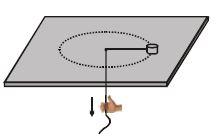
A small disk is attached to the end of a light inextensible string, which passes through a hole in a frictionless horizontal tabletop. Initially the disk moves on a circle of radius $R$ with kinetic energy $K_0$. The string is then slowly pulled so that the disk finally rotates on a circle of radius $\frac{R}{\eta }$. What is the work $W$ done in pulling the string
  • A
    $W = \eta^2K_0$
  • $W = (\eta^2 - 1)K_0 $
  • C
    $W = (\eta - 1)K_0 $
  • D
    $ W = 0$

Answer

Correct option: B.
$W = (\eta^2 - 1)K_0 $
b
Torque by tension force is zero

$\Rightarrow$ angular momentum conservation

$\mathrm{I}_{1} \mathrm{\omega}_{1}=\mathrm{I}_{2} \mathrm{\omega}_{2}$

Let $\mathrm{\omega}_{1}=\mathrm{\omega}_{0}$

$\mathrm{mR}^{2} \mathrm{\omega}_{0}=\frac{\mathrm{mR}^{2}}{\mathrm{n}^{2}} \mathrm{\omega}^{2}$

$\Rightarrow \mathrm{\omega}_{2}=\mathrm{\omega}_{0} \eta^{2}$

$=\left(\mathrm{k}_{0}=\frac{1}{2} \mathrm{I}_{1} \mathrm{\omega}^{2}\right)$

$\mathrm{k}_{0}=\frac{1}{2} \times\left(\mathrm{mR}_{0}^{2}\right) \mathrm{\omega}_{0}^{2}=\frac{\mathrm{m} \mathrm{R}_{0}^{2} \mathrm{\omega}_{0}^{2}}{2}$

Here change in $\mathrm{K} . \mathrm{E} .=(\mathrm{WD})$

$\mathrm{k}_{f}=\frac{1}{2} \mathrm{I}_{2} \mathrm{\omega}_{2}^{2}=\frac{1}{2} \times\left(\frac{\mathrm{mR}^{2}}{\eta^{2}}\right) \times \mathrm{\omega}_{0}^{2} \eta^{4}$

$=\left(\frac{1}{2} \mathrm{mR}^{2} \mathrm{\omega}_{0}^{2}\right) \eta^{2}$

$\mathrm{WD}=\mathrm{k}_{\mathrm{f}}-\mathrm{k}_{\mathrm{i}}=\frac{1}{2} \mathrm{mR}^{2} \mathrm{\omega}_{0}^{2}\left(\eta^{2}-1\right)$

$=k_{0}\left(\eta^{2}-1\right)$
Need a full question paper?

Generate a complete, print-ready paper with questions like this in minutes — across 16+ boards, with answer keys.

Start Generating Free

Similar questions

Two identical mass $m$ are connected to a massless string which is hung over two frictionless pulleys as shown in figure. If everything is at rest, what is the tension in the cord?
An elementary particle of mass $m$ and charge $+e$ is projected with velocity $v$ at a much more massive particle of charge $Ze$, where $Z > 0$. What is the closest possible approach of the incident particle
Two resistors are joined in parallel whose, resultant is $\frac{6}{5} \,\Omega$. One of the resistance wire is broken and the effective resistance becomes $2 \,ohms$. Then the resistance (in $ohm$) of the wire that got broken is ..........
The Young's modulus of a wire of length $L$ and radius $r$ is $Y$ $N/m^2$. If the length and radius are reduced to $L/2$ and $r/2,$ then its Young's modulus will be
When Ultraviolet radiation of a certain frequency falls on a potassium target, the photo electrons released can be stopped completely by a retarding potential of $0.6 \,V$. If the frequency of the radiation is increased by $10 \%$, this stopping potential rises to $0.9 \,V$. The work function of potassium is ........ $eV$
Wax is coated on the inner wall of a capillary tube and the tube is then dipped in water. Then, compared to the unwaxed capillary, the angle of contact $\theta $ and the height $h$ upto which water rises change. These changes are
An object is placed in front of a thin convex lens of focal length $30\, cm $ and a plane mirror is placed $15\, cm$ behind the lens. If the final image of the object coincides with the object, the distance of the object from the lens is.....$cm$
Two charges each of magnitude $Q$ are fixed at $2a$ distance apart. A third charge ($-q$ of mass $'m'$) is placed at the mid point of the two charges; now $-q$ charge is slightly displaced perpendicular to the line joining the charges then find its time period
A car accelerates from rest at a constant rate $\alpha$ for some time after which it decelerates at a constant rate $\beta$ to come to rest. If the total time elapsed is $t$ seconds, the total distance travelled is
In an experiment to measure the focal length ( $f$ ) of a convex lens, the magnitude of object distance $(x)$ and the image distance $(y)$ are measured with reference to the focal point of the lens. The $y-x$ plot is shown in figure. The focal length of the lens is___ $\mathrm{cm}$.