Question
A small electric car has a maximum constant acceleration of $1\,m / s ^2$, a maximum constant deceleration of $2\,m / s ^2$ and a maximum speed of $20\,m / s$. The amount of time it would take to drive this car $1\,km$ starting from rest and finishing at rest is $.........\,s$
Answer

(d)

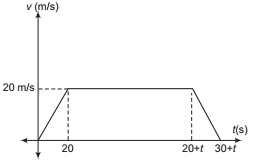
Car will acquire maximum speed i.e. $20\,m / s$ in $20\,s$ with an acceleration of $1\,m / s ^2$.In retardation, it will take $10\,s$. Suppose it moves with constant speed of $20\,m / s$ of $t$ second. Then,

Area of $v-t$ graph $=$ Total displacement or $\frac{1}{2}[t+30+t] \times 20=1000$ or

$\therefore$ Total time of journey $=(30+t)=65\,s$

Need a full question paper?

Generate a complete, print-ready paper with questions like this in minutes — across 16+ boards, with answer keys.

Start Generating Free

Similar questions

A particle of mass $10\, g$ moves along a circle of  radius $6.4\, cm$ with a constant tangential acceleration. What is the magnitude of this acceleration if the kinetic energy of the particle becomes equal to $8 \times 10^{-4}\,J$ by the end of the second revolution after the beginning of the motion $?$ .............. $\mathrm{m} / \mathrm{s}^{2}$
A student of mass $M$ is $1.5 \,m$ tall and has her centre of mass $1 \,m$ above ground when standing straight. She wants to jump up vertically. To do so. she bends her knees so that her centre of mass is lowered by $0.2 \,m$ and then pushes the ground by a constant force F. As a result, she jumps up such that the maximum height of her feet is $0.3 \,m$ above ground. The ratio $F / Mg$ is
Critical angle of incidence for a pair of optical media is $45^{\circ}$. The refractive indices of first and second media are in the ratio:
Which of the following modulated signal has the best noise-tolerance ?
A plane polarized monochromatic $EM$ wave is travelling a vacuum along $z$ direction such that at $t\, = t_1$ it is found that the electric field is zero at a spatial point $z_1$ . The next zero that occurs in its neighbourhood is at $z_2$. The frequency of the electromagnetic wave is:
A point charge $q$ is surrounded by eight identical charges at distance $r$ as shown in figure. How much work is done by the forces of electrostatic repulsion when the point charge at the centre is removed to infinity?
Light travels a distance $x$ in time $t_1$ in air and $10 x$ in time $t_2$ in another denser medium. What is the critical angle for this medium?
Two stars situated at distances of $1$ and $10 $ light years respectively from the earth appear to possess the same brightness. The ratio of their real brightness is
A film of water is formed between two straight parallel wires of length $10\,cm$ each separated by $0.5\, cm$. If their separation is increased by $1\, mm$ while still maintaining their parallelism, how much work will have to be done (Surface tension of water = $7.2 \times {10^{ - 2}}\,N/m)$
If force $(\overrightarrow F ) = 4\hat i + 5\hat j$ and displacement $(\overrightarrow s ) = 3\hat i + 6\hat k$ then the work done is