MCQ
A small mass $m$ is attached to a massless string whose other end is fixed at $P$ as shown in figure. The mass is undergoing circular motion in $x-y$ plane with centre $O$ and constant angular speed $\omega $ . If the angular momentum of the system, calculated about $O$ and $P$ and denoted by $\vec L_o$ and $\vec L_p$ respectively, then
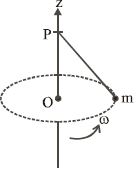
  • A
    ${\vec L_o}$ and ${\vec L_p}$ do not vary with time
  • B
    ${\vec L_o}$ varies with time while  ${\vec L_p}$ remains constant
  • ${\vec L_o}$ remains constant while ${\vec L_p}$ varies with time.
  • D
    ${\vec L_o}$ and ${\vec L_p}$ both vary with time
Answer

Correct option: C.
${\vec L_o}$ remains constant while ${\vec L_p}$ varies with time.
c
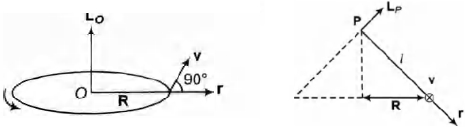
Angular momentum of a particle about a point is given by $L=r \times P=m(r \times v)$

For $\vec L_{0}$

$|\vec L|=(\text {mvrsin} \theta)=m(R \omega)(R) \sin 90^{\circ}=$ constant

Direction of $\vec L_{0}$ is always upwards. Therefore, complete $\vec L_{0}$ is constant, both in

magnitude as well as direction. For $\vec L_{p}$

$\left.\left|\vec L_{P}\right|=(\text {mvrsin} \theta)=(m)(R \omega)(l) \sin 90^{\circ}=(m R l \omega)\right)$

Magnitude of $\vec L_{P}$ will remain constant but direction of $\vec L_{P}$ keeps on changing.

Need a full question paper?

Generate a complete, print-ready paper with questions like this in minutes — across 16+ boards, with answer keys.

Start Generating Free