Question
A small plane area is rotated in an electric field. In which orientation of the area is the flux of electric field through the area maximum? In which orientation is it zero?

Answer

The flux of an electric field $\overrightarrow{\text{E}}$ through a surface area $\Delta\overrightarrow{\text{S}}$ is given by $\Delta\phi=\overrightarrow{\text{E}}.\Delta\overrightarrow{\text{S}},$ where $\Delta\phi$ is the flux.
Therefore, $\Delta\phi={\text{E}}\Delta{\text{S}}\cos\theta.$ Here, $\theta$ is the angle between the electric field $\overrightarrow{\text{E}}$ and the normal to the surface area.
Thus, for the flux to be maximum, $\cos\theta$ should be maximum. Thus, for $\theta=0,$ the flux is maximum, i.e. the electric field lines are perpendicular to the surface area.
The flux is minimum if $\theta=90.$ Thus, $\cos\theta=0$ and, hence, flux is also 0. Thus, if the electric field lines are parallel to the surface area, the flux is minimum.

Need a full question paper?

Generate a complete, print-ready paper with questions like this in minutes — across 16+ boards, with answer keys.
Start Generating Free

Similar questions

Calculate the moment of inertia of uniform circular disc of mass 500 g , radius 10 cm about
i. diameter of the disc
ii. the axis tangent to the disc and parallel to its diameter and
iii. the axis through the centre of the disc and perpendicular to its plane.
A current of $1.0A$ exists in a copper wire of cross-section $1.0mm^2$. Assuming one free electron per atom, calculate the drift speed of the free electrons in the wire. The density of copper is $9000kg/m^{-3}$.
In deriving Bernoulli’s equation, we equated the work done on the fluid in the tube to its change in the potential and kinetic energy.
  1. What is the largest average velocity of blood flow in an artery of diameter 2 × 10⁻³m if the flow must remain laminar?
  2. Do the dissipative forces become more important as the fluid velocity increases? Discuss qualitatively.
What do you understand by beat? Explain beats analytically.
A transverse harmonic wave on a string is described by
$\text{y}(\text{x, t})=3.0\sin\big(36\text{t}+0.018\text{x}+\frac{\pi}{4}\big)$
where x and y are in cm and t in s. The positive direction of x is from left to right.
Is this a travelling wave or a stationary wave?
If it is travelling, what are the speed and direction of its propagation?
Earthquakes generate sound waves inside the earth. Unlike a gas, the earth can experience both transverse $( S )$ and Iongitudinal ( $P$ ) sound waves. Typically the speed of $S$ wave is about $4.0 km s ^{-1}$, and that of $P$ wave is $8.0 km s ^{-1}$. A seismograph records P and S waves from an earthquake. The first P wave arrives 4 min before the first S wave. Assuming the waves travel in straight line, at what distance does the earthquake occur?
Describe Searl's method to determine Young's Modulus of elasticity and explain the behaviour of a stretched wire under increasing load.
A ballon has $5.0g$ mole of helium at $7°C$. Calculate.
  1. The number of atoms of helium in the balloon,
  2. The total internal energy of the system.
Describe the behavior of gases.
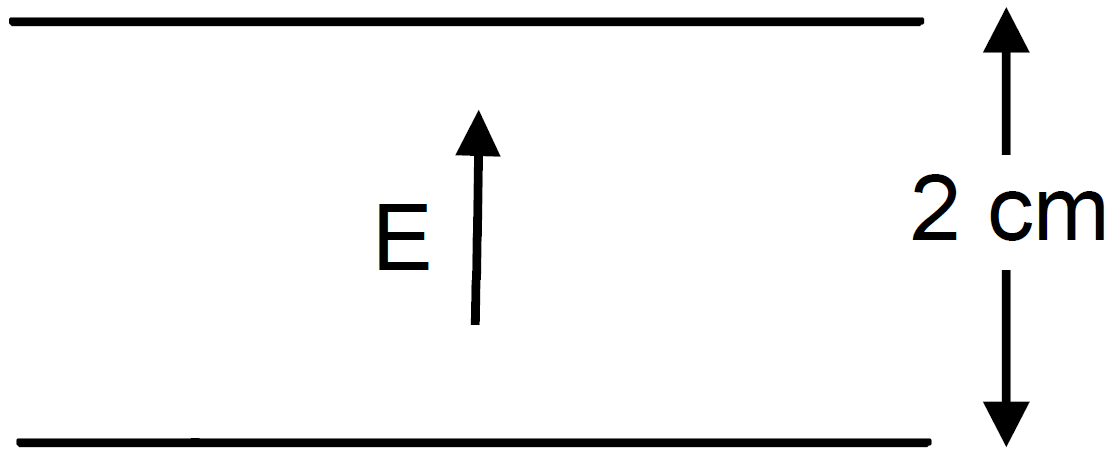
An electric field of magnitude $1000NC^{-1}$ is produced between two parallel plates having a separation of $2.0cm$ as shown in figure.
  1. What is the potential difference between the plates?
  2. With what minimum speed should an electron be projected from the lower plate in the direction of the field so that it may reach the upper plate?
  3. Suppose the electron is projected from the lower plate with the speed calculated in part (b). The direction of projection makes an angle of 60° with the field. Find the maximum height reached by the electron.