MCQ
A small spherical solid ball is dropped from a great height in a viscous liquid. Its journey in the liquid is best described in the diagram given below by the
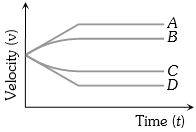
  • A
    Curve $A$
  • Curve $B$
  • C
    Curve $ C$ 
  • D
    Curve $ D$

Answer

Correct option: B.
Curve $B$
b
(b)

Need a full question paper?

Generate a complete, print-ready paper with questions like this in minutes — across 16+ boards, with answer keys.
Start Generating Free

Similar questions

The centre of mass of two masses $m$ and $m'$ moves by distance $\frac{x}{5}$ when mass $m$ is moved by distance $x$ and $m'$ is kept fixed. The ratio $\frac{m'}{m}$ is
A $U-$ tube is such that the diameter of one limb is $0.4\,mm$ and that of other is $d\, mm$ . If the surface tension of water contained in the tube is $0.07\,N/m$ and the difference in the levels of liquid in the limbs is $3.6\,cm,$ then the value of $d$ is
A uniform cylinder of length $L$ and mass $M$ having crosssectional area $A$ is suspended, with its length vertical, from a fixed point by a massless spring such that it is half submerged in a liquid of density $\sigma$ at equilibrium position. The extension $x_0$ of the spring when it is in equilibrium is
Two forces ${\vec F_1} = 5\hat i + 10\hat j - 20\hat k$ and ${\vec F_2} = 10\hat i - 5\hat j - 15\hat k$ act on a single point. The angle between ${\vec F_1}$ and ${\vec F_2}$ is nearly ....... $^o$
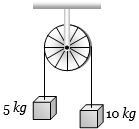
Two masses as shown are suspended from a massless pulley. Calculate the acceleration of the system when masses are left free
If speed of a particle moving in a circle of radius $2\,m$ is given as $v = 2t + 2$, then its centripetal acceleration after $1\, s$ will be   ......... $m/s^2$
The maximum height reached by a projectile is $64 \mathrm{~m}$. If the initial velocity is halved, the new maximum height of the projectile is_________.$\mathrm{m}$.
A tuning fork produces waves in a medium. If the temperature of the medium changes, then which of the following will change
The mass of a spaceship is $1000\ kg$. It is to be launched from the earth's surface out into free space. The value of $g$ and $R$( radius of earth) are $10\ m/s^2 $ and $6400\ km$ respectively. The required energy for this work will be
As the temperature of a metallic resistor is increased, the product of its resistivity and conductivity: