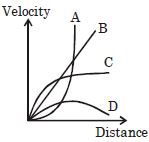
A small spherical solid ball is dropped in a viscous liquid. Its journey in the liquid is best described in the figure drawn by:-
Medium
Download our app for free and get started
Download our app
and get started for free
Experience the future of education. Simply download our apps or reach out to us for more information. Let's shape the future of learning together!No signup needed.*
When a large bubble rises from the bottom of a lake to the surface. Its radius doubles. If atmospheric pressure is equal to that of column of water height $H$, then the depth of lake is
If it takes $5\,minutes$ to fill a $15\,litre$ bucket from a water tap of diameter $\frac{2}{{\sqrt \pi }}cm$ then the Reynolds number for the flow is (density of water $= 10^3\,kg/m^3$ ) and viscosity of water $= 10^{-3}\,Pa.s$ ) close to
The cross sectional area of a horizontal tube increases along its length linearly, as we move in the direction of flow. The variation of pressure, as we move along its length in the direction of flow ($x-$ direction), is best depicted by which of the following graphs
A flat plate of area $10\,cm^2$ is separated from a large plate by a layer of glycerine $1\, mm$ thick. If the coefficient of viscosity of glycerine is $20$ poise, the force required to keep the plate moving with a velocity of $1\,cm/sec$ is .......... $dyne$
Glycerine of density $1.25 \times 10^3\,kg\,m ^{-3}$ is flowing through the conical section of pipe. The area of cross-section of the pipe at its ends is $10\,cm ^2$ and $5\,cm ^2$ and pressure drop across its length is $3\,Nm ^{-2}$. The rate of flow of glycerine through the pipe is $x \times 10^{-5} m ^3 s ^{-1}$. The value of $x$ is $..............$.
A small solid ball is dropped from a height above the free surface of a liquid. It strikes the surface of the liquid at $t = 0$. The density of the material of the ball is $500\ kg/m^3$ and that of liquid is $1000\ kg/m^3$ If the ball comes momeritariiy at rest at $t = 2\ sec$ then initial height of the ball from surface of liquid was ..... $m$ (neglect viscosity)
A wind with speed $40\,\, m/s$ blows parallel to the roof of a house. The area of the roof is $250\, m^2.$ Assuming that the pressure inside the house is atmospheric pressure, the force exerted by the wind on the roof and the direction of the force will be $(\rho _{air} = 1.2 \,\,kg/m^3)$