MCQ
A small spherical solid ball is dropped in a viscous liquid. Its journey in the liquid is best  described in the figure drawn by:-
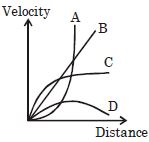
  • A
    curve $A$
  • B
    curve $B$
  • curve $C$
  • D
    curve $D$

Answer

Correct option: C.
curve $C$
c

Need a full question paper?

Generate a complete, print-ready paper with questions like this in minutes — across 16+ boards, with answer keys.
Start Generating Free

Similar questions

A rope of length $L$ and mass $M$ hangs freely from the ceiling. If the time taken by a transverse wave to travel from the bottom to the top of the rope is $T$, then time to cover first half length is
Orbit of a planet around a star is
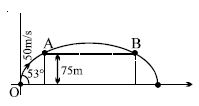
At $t = 0$ a projectile is fired from a point $O$(taken as origin) on the ground with a speed of $50\,\, m/s$ at an angle of $53^o$ with the horizontal. It just passes two points $A \& B$ each at height $75 \,\,m$ above horizontal as shown. The horizontal separation between the points $A$ and $B$ is ........ $m$
Two waves having equations

${x_1} = a\sin (\omega \,t + {\phi _1})$, ${x_2} = a\sin \,(\omega \,t + {\phi _2})$

If in the resultant wave the frequency and amplitude remain equal to those of superimposing waves. Then phase difference between them is
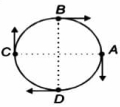
Four particles $A, B, C$ and $D$ are moving with constant speed $v$ each. At the instant shown relative velocity of $A$ with respect to $B, C$ and $D$ are in directions
$0.056 \,kg$ of Nitrogen is enclosed in a vessel at a temperature of $127\,^{\circ} C$. The amount of heat required to double the speed of its molecules is k cal. (Take $R =2$ $cal \,mole$ $^{-1} K ^{-1}$ )
The length of needle floating on the surface of water is $1.5\,cm$. The force in addition to its weight required to lift the needle from water surface will be...... $N$  (surface tension of water $= 7.5\,N/cm$ )
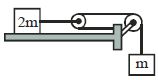
Consider the situation shown in figure. All the surfaces are smooth. The tension in the string connected to $2\,m$ is
A shell of mass $M$ and radius $R$ has a point mass m placed at a distance $r$ from its centre. The gravitational potential energy $U \,(r)$ vs $r$ will be
A particle initially at rest is subjected to two forces. One is constant, the other is a retarding force proportional to the particle velocity. In the subsequent motion of the particle :