MCQ
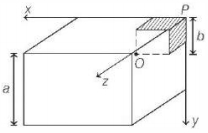
A smaller cube with side $b$ (depicted by dashed lines) is excised from a bigger uniform cube with side $\alpha$ as shown below, such that both cubes have a common vertex $P$. Let $X=a / b$. If the centre of mass of the remaining solid is at the vertex $O$ of smaller cube, then $X$ satisfies
  • $X^3-X^2-X-1=0$
  • B
    $X^2-X-1=0$
  • C
    $X^3+X^2-X-1=0$
  • D
    $X^3-X^2-X+1=0$

Answer

Correct option: A.
$X^3-X^2-X-1=0$
a
(a)

We choose origin at point $P$.

Now, given centre of mass of remaining solid is at point $O$. Coordinates of $O$ as per axes choosen are $O \equiv(b, b, b)$

i.e. $x=b, y=b$ and $z=b$

Centre of mass of complete large cube lies at its centre.

$\therefore$ Coordinates of centre of mass of large cube are $x_1=\frac{a}{2}, y_1=\frac{a}{2}, z_1=\frac{ a }{2}$

And centre of mass of removed cube of side $b$ is $x_2=\frac{b}{2}, y_2=\frac{b}{2}, z_2=\frac{b}{2}$.

Treating removed mass as negative mass, we have

$x_{ CM }\left(\right.$ of remaining part) $=\frac{m_1 x_1-m_2 x_2}{m_1-m_2}$

$\Rightarrow \quad b=\frac{\rho a^3 \times \frac{a}{2}-\rho b^3 \times \frac{b}{2}}{\rho a^3-\rho b^3}$

where, $\rho=$ mass density.

$\Rightarrow \quad a^3 b-b^4=\frac{a^4}{2}-\frac{b^4}{2}$

$\Rightarrow \quad \frac{a^3}{b^3}-1=\frac{a^4}{2 b^4}-\frac{1}{2}$

As $X=\frac{ a }{b}$, we have

$X^{-3}-1=\frac{X^4}{2}-\frac{1}{2}$

$\Rightarrow \quad 2 X^3-1=X^4$

$\Rightarrow \quad 2\left(X^3-1\right)=X^4-1$

$\Rightarrow 2(X-1)\left(X^2+1+X\right)$

$=(X-1)(X+1)\left(X^2+1\right)$

$\Rightarrow \quad X^3-X^2-X-1=0$
Need a full question paper?

Generate a complete, print-ready paper with questions like this in minutes — across 16+ boards, with answer keys.

Start Generating Free

Similar questions

Choose the correct relationship between Poisson ratio $(\sigma)$. bulk modulus $( K )$ and modulus of rigidity $(\eta)$ of a given solid object:
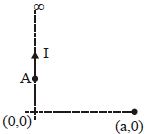
An infinitely long wire carrying current $I$ is along $Y$ axis such that its one end is at point $A(0, b)$ while the wire extends upto $+ \infty .$ The magnitude of magnetic field strength at point $(a, 0)$
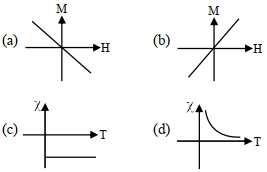
Following plots show Magnetization $(M)$ $vs$ Magnetising field $(H)$ and Magnetic susceptibility $(\chi)$ vs temperature $(T)$ graph :

Which of the following combination will be represented by a diamagnetic material?

When two small bubbles join to form a bigger one, energy is
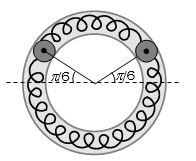
Two identical balls A and B each of mass 0.1 kg are attached to two identical massless springs. The spring mass system is constrained to move inside a rigid smooth pipe bent in the form of a circle as shown in the figure. The pipe is fixed in a horizontal plane. The centres of the balls can move in a circle of radius 0.06 m. Each spring has a natural length of 0.06$\pi$ m and force constant 0.1N/m. Initially both the balls are displaced by an angle $\theta = \pi /6$ radian with respect to the diameter $PQ$ of the circle and released from rest. The frequency of oscillation of the ball B is
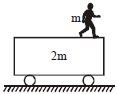
A man is standing on a cart of mass double the mass of man. Initially cart is at rest. Now man jumps horizontally with relative velocity $'u'$ with respect to cart. Then work done by internal forces of the man during the process of jumping will be :
A flexible wire bent in the form of a circle is placed in a uniform magnetic field perpendicular to the plane of the coil. The radius of the coil changes as shown in figure. The graph of induced $emf$ in the coil is respresented by
When an impurity is doped into an intrinsic semiconductor, the conductivity of the semiconductor
If the current is halved in a coil, then the energy stored is how much times the previous value
A solid sphere of radius $R$ and density $\rho$ is attached to one end of a mass-less spring of force constant $k$. The other end of the spring is connected to another solid sphere of radius $R$ and density $3 p$. The complete arrangement is placed in a liquid of density $2 p$ and is allowed to reach equilibrium. The correct statement$(s)$ is (are)

$(A)$ the net elongation of the spring is $\frac{4 \pi R^3 \rho g}{3 k}$

$(B)$ the net elongation of the spring is $\frac{8 \pi R^3 \rho g}{3 k}$

$(C)$ the light sphere is partially submerged.

$(D)$ the light sphere is completely submerged.