MCQ
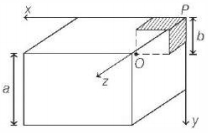
A smaller cube with side $b$ (depicted by dashed lines) is excised from a bigger uniform cube with side $\alpha$ as shown below, such that both cubes have a common vertex $P$. Let $X=a / b$. If the centre of mass of the remaining solid is at the vertex $O$ of smaller cube, then $X$ satisfies
  • $X^3-X^2-X-1=0$
  • B
    $X^2-X-1=0$
  • C
    $X^3+X^2-X-1=0$
  • D
    $X^3-X^2-X+1=0$

Answer

Correct option: A.
$X^3-X^2-X-1=0$
a
(a)

We choose origin at point $P$.

Now, given centre of mass of remaining solid is at point $O$. Coordinates of $O$ as per axes choosen are $O \equiv(b, b, b)$

i.e. $x=b, y=b$ and $z=b$

Centre of mass of complete large cube lies at its centre.

$\therefore$ Coordinates of centre of mass of large cube are $x_1=\frac{a}{2}, y_1=\frac{a}{2}, z_1=\frac{ a }{2}$

And centre of mass of removed cube of side $b$ is $x_2=\frac{b}{2}, y_2=\frac{b}{2}, z_2=\frac{b}{2}$.

Treating removed mass as negative mass, we have

$x_{ CM }\left(\right.$ of remaining part) $=\frac{m_1 x_1-m_2 x_2}{m_1-m_2}$

$\Rightarrow \quad b=\frac{\rho a^3 \times \frac{a}{2}-\rho b^3 \times \frac{b}{2}}{\rho a^3-\rho b^3}$

where, $\rho=$ mass density.

$\Rightarrow \quad a^3 b-b^4=\frac{a^4}{2}-\frac{b^4}{2}$

$\Rightarrow \quad \frac{a^3}{b^3}-1=\frac{a^4}{2 b^4}-\frac{1}{2}$

As $X=\frac{ a }{b}$, we have

$X^{-3}-1=\frac{X^4}{2}-\frac{1}{2}$

$\Rightarrow \quad 2 X^3-1=X^4$

$\Rightarrow \quad 2\left(X^3-1\right)=X^4-1$

$\Rightarrow 2(X-1)\left(X^2+1+X\right)$

$=(X-1)(X+1)\left(X^2+1\right)$

$\Rightarrow \quad X^3-X^2-X-1=0$
Need a full question paper?

Generate a complete, print-ready paper with questions like this in minutes — across 16+ boards, with answer keys.

Start Generating Free

Similar questions

The potential energy of a body is given by, $U =A - B{x^2}$(Where x is the displacement). The magnitude of force acting on the particle is
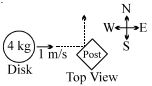
$A$ $4$ -kilogram disk slides over level ice toward the east at a velocity of $1$ meter per second, as shown. The disk strikes a post and rebounds toward the north at the same speed. The change in the magnitude of the eastward component of the momentum of the disk is ............. $\mathrm{kg}$ $ \cdot $ $\mathrm{m}/ \mathrm{s}$ 
A standing wave exists in a string of length $150\ cm$ , which is fixed at both ends with rigid supports . The displacement amplitude of a point at a distance of $10\ cm$ from one of the ends is $5\sqrt 3\ mm$ . The nearest distance between the two points, within the same loop and havin displacment amplitude equal to $5\sqrt 3\  mm$ is $10\ cm$ . Find the maximum displacement amplitude of the particles in the string .... $mm$
A mass of $0.5\,kg$ moving with a speed of $1.5 \,m/s$ on a horizontal smooth surface, collides with a nearly weightless spring of force constant $k = 50\;N/m$. The maximum compression of the spring would be ............. $\mathrm{m}$
Inside a horizontally moving box, an experimenter finds that when an object is placed on a smooth horizontal table and is released, it moves with an acceleration of $10\,m / s ^2$. In this box if $1\,kg$ body is suspended with a light string, the tension in the string in equilibrium position (w.r.t. experimenter) will be$.........\,N$ (Take $g =10\,m / s ^2$ )
The ratio of intensities between two coherent soud sources is $4 : 1$. The differenmce of loudness in $dB$ between maximum and minimum intensities when they interfere in space is:
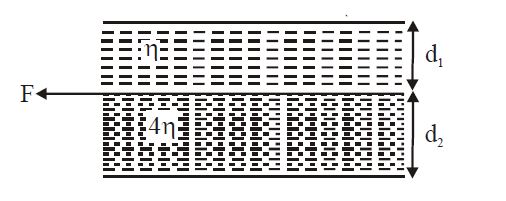
A thin plate separates two liquids of coefficients of viscosity $\eta$ and $4\ \eta$ kept between two fixed plates as shown. If plate has to be pulled by applying minimum force then $\frac{d_2}{d_1}$ is
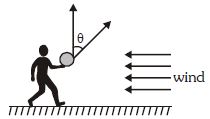
A body throws a ball upwards with velocity $v_0 = 20\, m/s$ . The wind imparts a horizontal acceleration of $4\, m/s^2$ to the ball. The angle $\theta $ from vertical at which the ball must be thrown so that the ball returns to the boy's hand is $(g = 10\, m/s^2)$
A ball is projected from the ground at an angle of $45^{\circ}$ with the horizontal surface. It reaches a maximum height of $120 m$ and returns to the ground. Upon hitting the ground for the first time, it loses half of its kinetic energy. Immediately after the bounce, the velocity of the ball makes an angle of $30^{\circ}$ with the horizontal surface. The maximum height it reaches after the bounce, in metres, is. . . . .
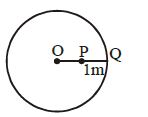
Two spheres $P$ and $Q$ of equal masses are attached to a string of length $2\,\, m$ as shown in figure. The string and the spheres are then whirled in a horizontal circle about $O$ at a constant rate. What is the value of the ratio
$\left( {\frac{{{\text{Tension in the string between P and Q}}}}{{{\text{Tension in the string between P and O}}}}} \right)?$