MCQ
A smooth sphere $A$ is moving on a frictionless horizontal plane with angular speed $\omega $ and center of mass with velocity $v$. It collides elastically and head-on with an identical sphere $B$ at rest. Neglect friction everywhere. After the collision, their angular speeds are ${\omega _A}$ and ${\omega _B}$ respectively. Then
  • A
    ${\omega _A} < {\omega _B}$
  • B
    ${\omega _A} = {\omega _B}$
  • ${\omega _A} = \omega $
  • D
    $\omega = {\omega _B}$

Answer

Correct option: C.
${\omega _A} = \omega $
c
As the spheres are smooth there will be no friction (no torque) and therefore there will be no transfer of angular momentum. Thus $\mathrm{A}$, after collision will remain with its intial angular momentum $i . e ., \omega_{A}=\omega$

Need a full question paper?

Generate a complete, print-ready paper with questions like this in minutes — across 16+ boards, with answer keys.

Start Generating Free

Similar questions

The distance covered by a body of mass $5\,g$ having linear momentum $0.3\,kg\,m / s$ in $5\,s$ is $..........\,m$
A body of weight $200 \mathrm{~N}$ is suspended form a tree branch thought a chain of mass $10 \mathrm{~kg}$. The branch pulls the chain by a force equal to (if $g=10 \mathrm{~m} / \mathrm{s}^2$ ):
The fundamental frequency of a sonometre wire is $n.$ If its radius is doubled and its tension becomes half, the material of the wire remains same, the new fundamental frequency will be
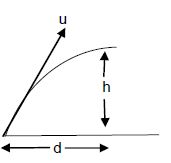
If a stone is to hit at a point which is at a distance $d$ away and at a height $h$ above the point from where the stone starts, then what is the value of initial speed $u$ if the stone is launched at an angle $\theta $ ?
A particle executes a simple harmonic motion of time period $T$. Find the time taken by the particle to go directly from its mean position to half the amplitude
If the time of flight of a bullet over a horizontal range $R$ is $T$, then the angle of projection with horizontal is ......
A metal ball falls from a height of $32$ metre on a steel plate. If the coefficient of restitution is $0.5$, to what height will the ball rise after second bounce ............ $m$
A uniform sphere is placed on a smooth horizontal surface and a horizontal force F is applied on it at a distance h above the surface. The acceleration of the centre:
The speed of light $(c)$, gravitational constant $(G)$ and planck's constant $(h)$ are taken as fundamental units in a system. The dimensions of time in this new system should be
The ratio of maximum acceleration to maximum velocity in a simple harmonic motion is $10\,s^{-1}$.  At, $t = 0$ the displacement is $5\, m$. What is the maximum acceleration ? The initial phase is $\frac{\pi }{4}$