A solenoid of $N$ turn, $'l'$ length and $'r'$ radius of cross - section. If current $i$ flow in solenoid then magnetic field at axial mid point will be (where $l\, \simeq \,\,r$ )
Diffcult
Download our app for free and get started
$\mathrm{B}_{\mathrm{m}}=\frac{\mu_{0} \mathrm{nI}}{2}\left[\cos \theta-\cos \left(180^{\circ}-\theta\right)\right]$
$=\frac{\mu_{0} \mathrm{nI}}{2}(\cos \theta+\cos \theta)$
$=\mu_{0}$$nIcos $$\theta,$ where $\cos \theta=\frac{\ell / 2}{\sqrt{\mathrm{r}^{2}+(\ell / 2)^{2}}}, \mathrm{n}=\frac{\mathrm{N}}{\ell}$
$=\mu_{0} \frac{\mathrm{N}}{\ell} \mathrm{I} \frac{(\ell / 2)}{\sqrt{\mathrm{r}^{2}+\ell^{2} / 4}}=\mu_{0}\left(\frac{\mathrm{N}}{\ell}\right) \mathrm{I} \frac{\ell}{\sqrt{4 \mathrm{r}^{2}+\ell^{2}}}$
$=\frac{\mu_{0} \mathrm{NI}}{\sqrt{4 \mathrm{r}^{2}+\ell^{2}}}$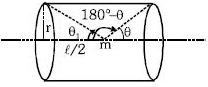

Download our appand get started for free
Experience the future of education. Simply download our apps or reach out to us for more information. Let's shape the future of learning together!No signup needed.*
Similar Questions
- 1The magnetic moments associated with two closely wound circular coils $A$ and $B$ of radius $r_A=10 cm$ and $r_B=20 cm$ respectively are equal if: (Where $N _A, I _{ A }$ and $N _B, I _{ B }$ are number of turn and current of $A$ and $B$ respectively)View Solution
- 2Consider two thin identical conducting wires covered with very thin insulating material. One of the wires is bent into a loop and produces magnetic field $B_1,$ at its centre when a current $I$ passes through it.The second wire is bent into a coil with three identical loops adjacent to each other and produces magnetic field $B_2$ at the centre of the loops when current $I/3$ passes through it. The ratio $B_1 : B_2$ isView Solution
- 3A $3.0\; cm$ wire carrying a current of $10 \;A$ is placed inside a solenoid perpendicular to its axis. The magnetic field inside the solenoid is given to be $0.27\; T$. What is the magnetic force on the wire?View Solution
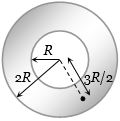
- 4Figure shows the cross-sectional view of the hollow cylindrical conductor with inner radius '$R$' and outer radius '$2R$', cylinder carrying uniformly distributed current along it's axis. The magnetic induction at point '$P$' at a distance $\frac{{3R}}{2}$ from the axis of the cylinder will beView Solution
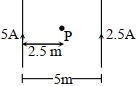
- 5For adjoining fig., The magnetic field at point, $P$ will beView Solution
- 6This question has Statement $1$ and Statement $2$ . Of the four choices given after the Statements, choose the one that best describes the two Statements.View Solution
Statement $1$: A charged particle is moving at right angle to a static magnetic field . During the motion the kinetic energy of the charge remains unchanged.
Statement $2$: Static magnetic field exert force on a moving charge in the direction perpendicular to the magnetic field.
- 7A galvanometer of resistance $25\,\Omega $ gives full scale deflection for a current of $10$ milliampere, is to be changed into a voltmeter of range $100\, V$ by connecting a resistance of $‘R’$ in series with galvanometer. The value of resistance $R$ in $\Omega $ isView Solution
- 8View SolutionConsider the following statements regarding a charged particle in a magnetic field . Which of the statements are true :
- 9An electron is moving along $+x$ direction. To get it moving along an anticlockwise circular path in $x-y$ plane, magnetic field applied alongView Solution
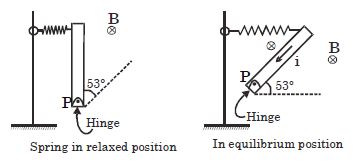
- 10A thin uniform rod with negligible mass and length $l$ is attached to the floor by a frictionless hinge at point $P$ . A horizontal spring with force constant $k$ connects the other end to wall. The rod is in a uniform magnetic field $B$ directed into the plane of paper. What is extension in spring in equilibrium when a current $i$ is passed through the rod in direction shown. Assuming spring to be in natural length initially.View Solution